Showing posts with label life expectancy. Show all posts

Friday, July 7, 2023

Life In Japan: Rice Balls


When Americans needs to eat on the fly, they grab a hamburger.

When Japanese need to eat on the fly, they grab a rice ball.

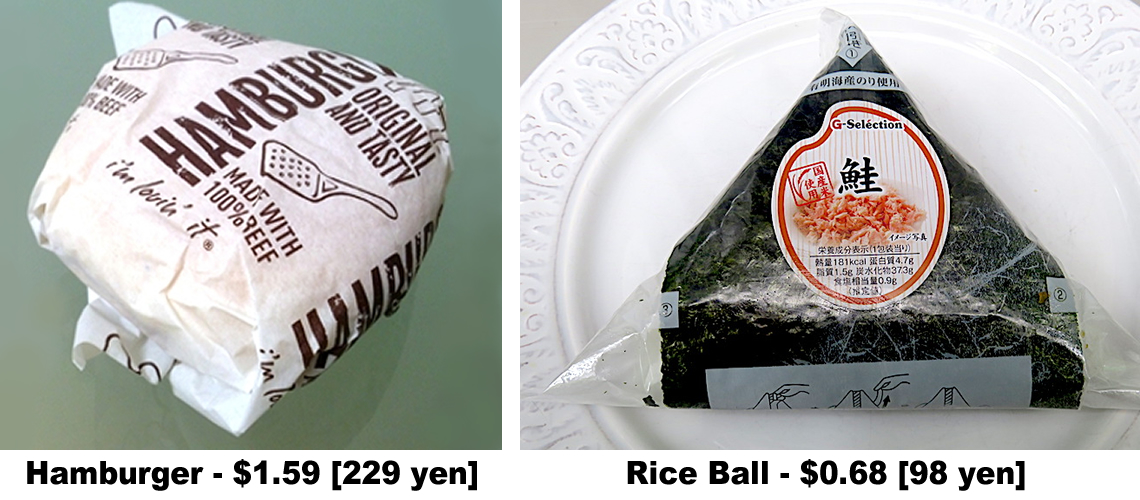
The basic rice ball — actually there are no fancy rice balls — costs around 98 yen [$0.68].

Hamburgers can of course be upgraded with an enormous array of options. In an upscale restaurant, they can be over $18.00, in that case with the hamburger experience significantly enhanced by having it delivered to your table — the one with a view of the city skyline — by a lovely waitress or handsome waiter, smiling ear-to-ear. Even at McDonald’s, a Double Bacon Quarter Pounder with cheese sets you back $6.99 [1005 yen]. The most basic hamburger at McDonald’s — meat and bun, no cheese — pictured above, is $1.59 [229 yen], almost 2 1/2 times what a rice ball costs.

Then again, you get a lot in an American hamburger that you don’t get in a Japanese rice ball. There’s the preservatives, the growth hormones, the antibiotics, the residues of pesticides and herbicides, the traces of antipsychotics, blood pressure modulators, sleep aids, cocaine, MDMA and other recreational drugs commonly found in the drinking water in the U.S., micro-plastics, maybe depleted uranium.

Both being fast foods, hamburgers and rice balls come ready to eat. Theoretically, you can start chomping them down as soon as you pay for them, right at the check-out counter. For certain, you can eat them in your car or even walking to your car.

Unwrapping them is slightly different. I’ve had friends back in the U.S. who actually don’t even bother unwrapping a McDonald’s hamburger. They eat the wrapping right along with the burger and say it tastes pretty much the same, nice and greasy.

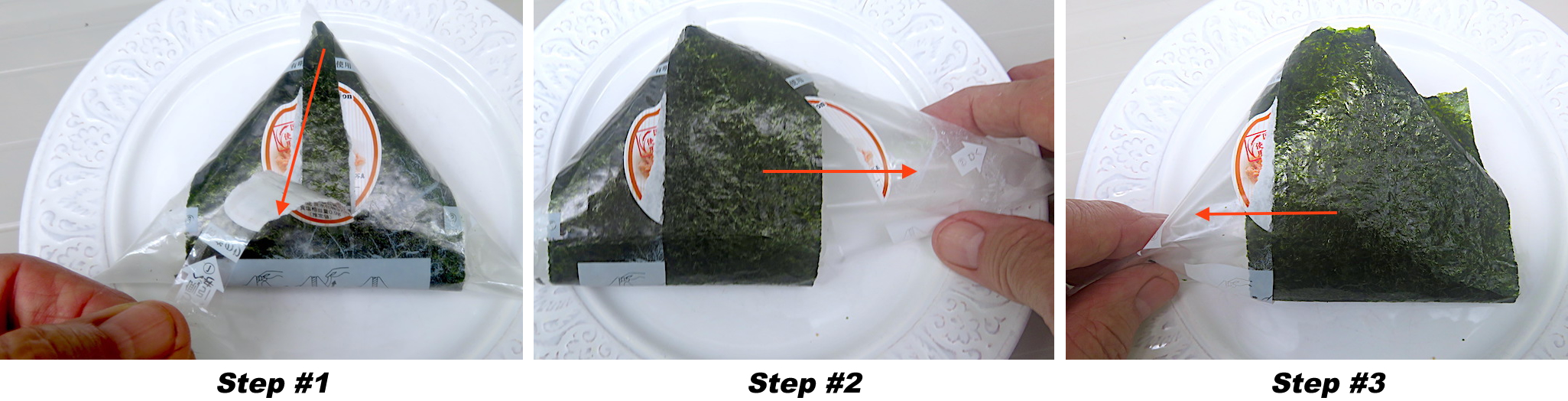
Unwrapping the rice ball is a little more involved. Masumi patiently instructed me in what she calls the 1-2-3 method and with some practice, I managed to master it. Here it is . . .
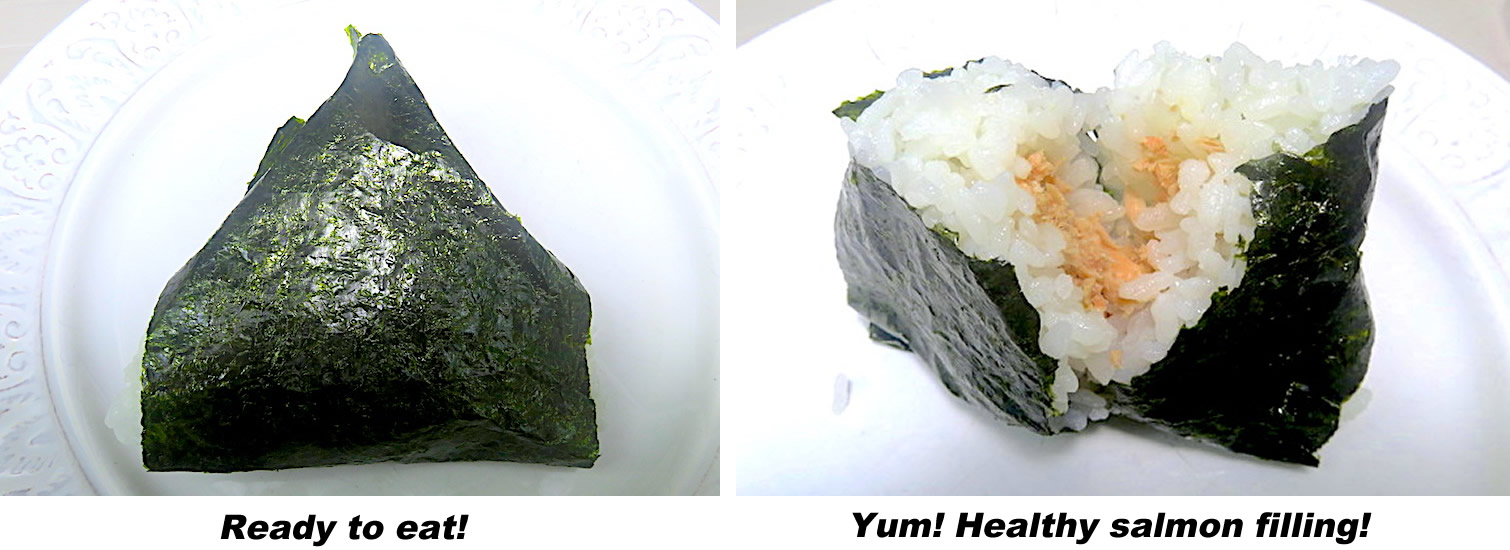
Now as long as this went according to plan, the delicious rice ball is ready for consumption!
Every culture has its advantages and disadvantages. I really love a good hamburger but I was never convinced that McDonald’s hamburgers were actual food. A long long time ago, when I was a pimply 20-something musician, I confess to being hooked on Big Macs. I recall they tasted really good, especially sitting in a park listening to some other local band.

Nutritional advice was not so readily available back then, at least not to the dumb-downed public, of which I was a clueless member. The most profound meme — this was before the word ‘meme’ had even been invented — on eating was: ‘You are what you eat.’ Which was among the reasons I never ate truck tires or dog poop.

Now, everything you wanted to know and a lot you don’t want to know is available on the web. There are no excuses for the eating habits — and yes, they are habits — of people and countries.

I’m not going to preach. I’ll close by making a couple points . . .

First, the most delicious rice ball doesn’t come close to tasting as good as the most delicious hamburger. That’s just a reality.

Here’s another reality, a statistical reality.

The life expectancy in the U.S. is 76.1 and falling. The life expectancy in Japan is 85.0 and rising.

Conclusion: Choose what you eat as if your life depended on it.


[ This originated at the author's personal website . . . https://jdrachel.com ]


Life In Japan: Rice Balls | John Rachel


Wednesday, August 24, 2022

Life In Japan: ‘Japan Pom Pom’

They claim proof in this video that age is a state of mind. Well, I’m not quite convinced of that. If a toddler just had a different attitude, he could start using chopsticks or master the Argentine Tango? When your heart stops beating or your kidneys quit functioning, it’s because you’re looking at things wrong? I don’t think so.

At the same time, state of mind is important in achieving a balanced, healthy perspective on age, whatever the number turns out to be. That’s the real message and it’s a good one.

At my advanced age, I love Japan, and Asia in general, because here they don’t demote or disappear people just because they were born a long time ago. The youth culture — should I say ‘youth-worshipping’ culture? — of most Western countries requires that old people be written off as persona non grata, once they get crows feet, or most certainly when they are no longer reproductive-capable. Or as my now deceased friend, British TV character actor David Rayner, liked to say: “We become invisible.”

Morita-san here is in his 70s, his parents in their 90s. They lived with him until they passed away, a few years after I took this photo.

By contrast, older folks here are respected, often revered, assigned a special, important place in their communities and families. Where it’s standard protocol in the West to get gramps and grannie into a retirement home or elderly care facility — out-of-sight out-of-mind — as soon as the old codgers agree to live in a pre-death camp, here it is extremely common for the oldest members of the family to live with their sons and daughters and their spouses until they die. I had an English student in his 70s whose parents, both pushing 100, lived with him and his wife until they passed away. This is customary.

At 84.67 years, Japan has the second-highest life expectancy in the world, right behind Hong Kong. This is largely attributed to diet and an excellent health care system. I’m sure “state of mind” plays some role. First, Japanese expect to live a long time. Second, they do not let age hinder them from fully participating in society, at whatever level makes sense. Many refuse to retire and work into their 70s, 80s, 90s. I wrote back in November 2020 about Silver-san, aka Jinzai Centers. Jinzai — 人材 — means human resources. But what makes these work centers special is they only employ people over 65.

Then again, it’s not just about work. Contrary to stereotypes about Japanese people, they do like to have fun. Which brings me to the central topic of this piece . . . Japan Pom Pom!

As you already suspect, this is a cheerleading squad. But what makes it unique is all of the ladies in it are over 55, the average age being 70. Their nickname is ‘The Cheerleading Grannies’. It’s the brainchild of Fumi Takino, an 85-year-old resident of Tokyo, who wolfs down pizza, and drinks beer and Coke like a 16-year-old high school exchange student.

The video at the top tells the entire story. I really have nothing to add, except this: If you’re feeling old and thinking about just surrendering to deterioration, convinced that your “old age” has condemned you to hopelessness and inevitable decline, watch the Cheerleading Grannies. If you don’t find it a shot of inspiration or a strong case for unfettered optimism, I’m confident you’ll at least enjoy a smile.

Bonus video: If you’re really in need of a good jaw-dropping, check out this performance by 94-year-old Johanna Quaas, from Germany — the oldest active gymnast in the world!

Age is a state of mind? Only if your state of mind is ageless.


[ This originated at the author's personal website . . . https://jdrachel.com ]


Life In Japan: ‘Japan Pom Pom’ | John Rachel