Yesterday was a national holiday here in Japan.
I didn’t give it much thought. Of course, I was extremely glad that Masumi, my wife, had time off from teaching school, and we could spend the entire day together. Moreover, a major typhoon was heading our way, so we were preoccupied with preparing the house and garden for a combative assault by Mother Nature.
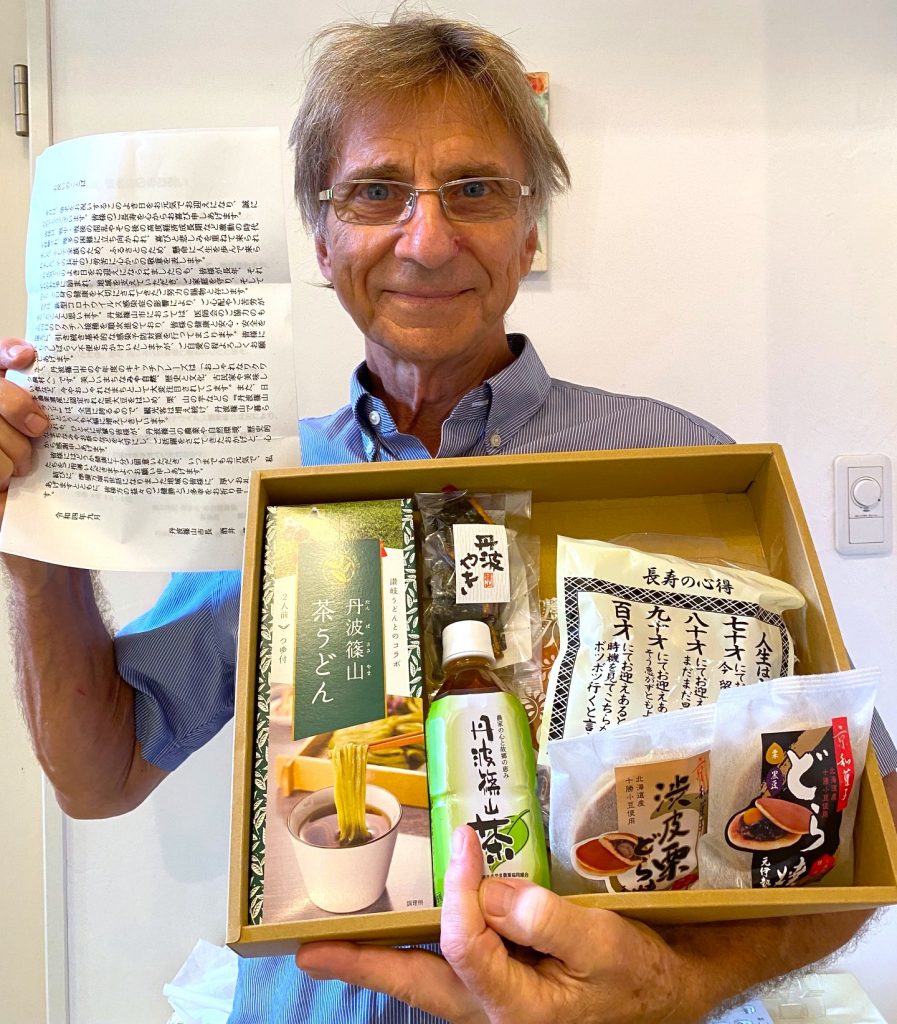
Then the doorbell rang. I answered it and there stood a gentleman from my local village. He handed me the gift package pictured above. Then it hit me . . .
It’s Respect for the Aged Day!
As I’ve explained before, national holidays here in Japan are by Western standards rather unique. Overall they are not nationalistic. They are more cultural. But they’re not like Mother’s Day or Father’s in the West, which are more like National Cat Day or National Talk in An Elevator Day, which aren’t official holidays at all. These national holidays, which celebrate everything from coming of age (turning 20) to mountains and children, are official holidays! The banks, post offices and most businesses are closed.
Now get this! Because yesterday was Respect for the Aged Day, every person in my small city of about 50,000 people who was 75 or over, received a gift package from the city. Let that sink in!
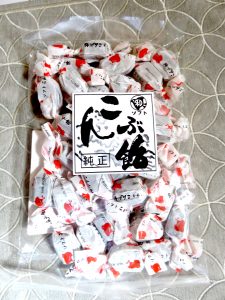
The package consisted of Japanese tea, and various treats. There were a couple cakes that were scrumptious! But I admit that I find some snacks here a little odd. In this package, there were seaweed crackers, pancakes filled with red bean sauce, green tea flavored udon (noodles). What you see on the right is kelp candy. No, that’s not a typo. It’s chewy candy made from kelp, harvested from the sea. It’s like munching on licorice that has no flavor.
As they say, it’s the thought that counts. And the thought here is one of extraordinary generosity and kindness.
By the way, there was a special letter included in the box. It conveyed a charming message of appreciation. Paraphrasing, it said: “You’ve lived many years, faced difficult challenges in your life, struggled against adversity. The people of Tambasasayama want to thank you for your hard work and your dedication and service to others. May you continue in good health and live a long and happy life.”
As ‘racism’ is discrimination based on race, in the West, ‘ageism’ is discrimination based on age. Someone is elderly, thus they are not accorded the same rights and courtesies as someone younger. They are dismissed personally as less able, and socially as less worthy. But here in Japan, ‘ageism’ — if there is such a thing — has the opposite effect. Ageism here accords an elderly person greater respect, preferential treatment, additional courtesies and admiration based on their advanced age.
What a completely different, and for me at 76, awe-inspiring attitude! Getting older may be inevitable. But in Japan, it doesn’t equate to being “disappeared” or forced to live in the margins of someone else’s life. The kids here don’t shuttle mom and dad off to some convalescent home when they get old, then visit them once a month, if they’re not too busy. The kids here make a room for them in their own home and they all live together again as a family.
Let that sink in!

I’ve written before about the uniquely wonderful national holidays Japan celebrates. It’s also talked about in my book LIVE FROM JAPAN!
This past Monday was 敬老の日, Keirō no Hi, Respect for the Aged Day here, my wife had the day off from teaching, and we had a barbecue celebration with her mother (definitely an aged person) and her older daughters. It was a splendid little party in the pergola I built a couple years ago.
Just before our festivities got fully rolling, I got a visit from one of my neighbors. The word had reached the highest government institutions. John Rachel turned 75 this summer, making me an official member of the “aged”. Not to diminish the prestige or importance of reaching this chronological benchmark, it’s not really a very exclusive club. People live very long lives here, and Japan this year recorded more people age 100 or above than ever in its history.
In any case, my neighbor brought with him gifts, those in the photo at the top.
The box of treats, including crackers and tea, was from the greater Tambasasayama area community. The bottle of expensive sake was from the mayor! He even wrote a letter of congratulations.
I suspect that this lovely gift-giving gesture was probably just a practice of my home town and other similar ones, modest size cities with more cohesion and sociability, and not the norm in the big cities.
But what a great touch on top of having a whole national holiday dedicated to us old folks!
And what a great way to make an “outsider” like me feel welcome in this charming and always amazing country, full of heart and adventure.
Finally, I have to draw attention to one of the treats.
Here is the rough translation of the messages on the package.
Life begins at 70.
When the angel comes for you at 70, tell him you’re not home.
When the angel comes for you at 80, tell him it’s too early.
When the angel comes for you at 90, tell him you’re not in a hurry.
When the angel comes for you at 100, tell him when the time comes you’ll be there.
Hmm. I assume the angel(s) speak Japanese. I think I better get cracking and make sure I’m up to speed with my command of the language!