Showing posts with label health care. Show all posts

Friday, February 6, 2026

Life In Japan: A New Crown!

Last week, I got a new crown!

No . . . NOT THAT type of crown. One for a tooth that fell apart. It had a crown from long ago but that fell out leaving a jagged mess of a molar.

Now, we have in Japan what most Americans would call “socialized medicine”, a one-payer, government health insurance program, strict controls which prevent profiteering, and national standards for everything medical.

Uh-oh! Socialized medicine! That means long waits to get help, crowded waiting rooms, inferior service, all the problems that come with massive bureaucracy.

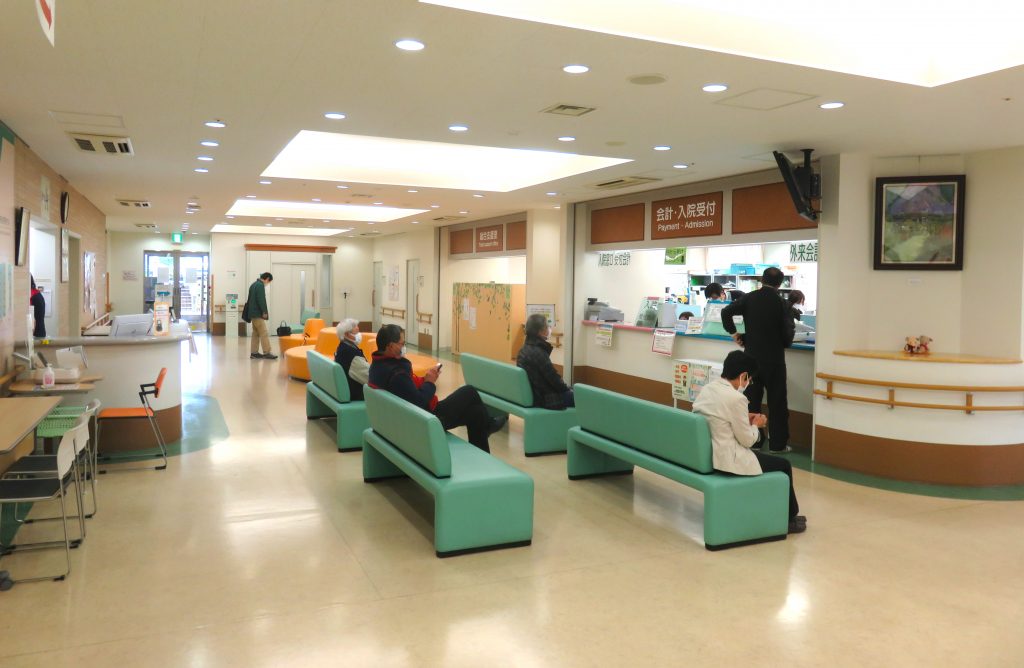
Well, I got an initial appointment within 48 hours, and only waited about ten minutes to get in to see the dentist. He took an X-ray, an impression, then filled the exposed area of the tooth with a temporary filler. One week later, after maybe a five minute wait in the reception area, he cemented in the new crown — which, by the way, fit perfectly and didn’t require any grinding or adjustments — and sent me on my way.

Two appointments, a total of less than 40 minutes in the dentist chair, and I had a new crown!

Now some research (here and here) tells me this: “Typical prices in the U.S. for a molar dental crown range from about $800 to $3,000 per tooth before insurance, depending on factors such as the material used (metal, porcelain‑fused‑to‑metal, zirconia, etc.), geographic location, and any additional procedures required. With dental insurance, out‑of‑pocket costs often fall between $400 and $1,200, but exact amounts vary by plan.”

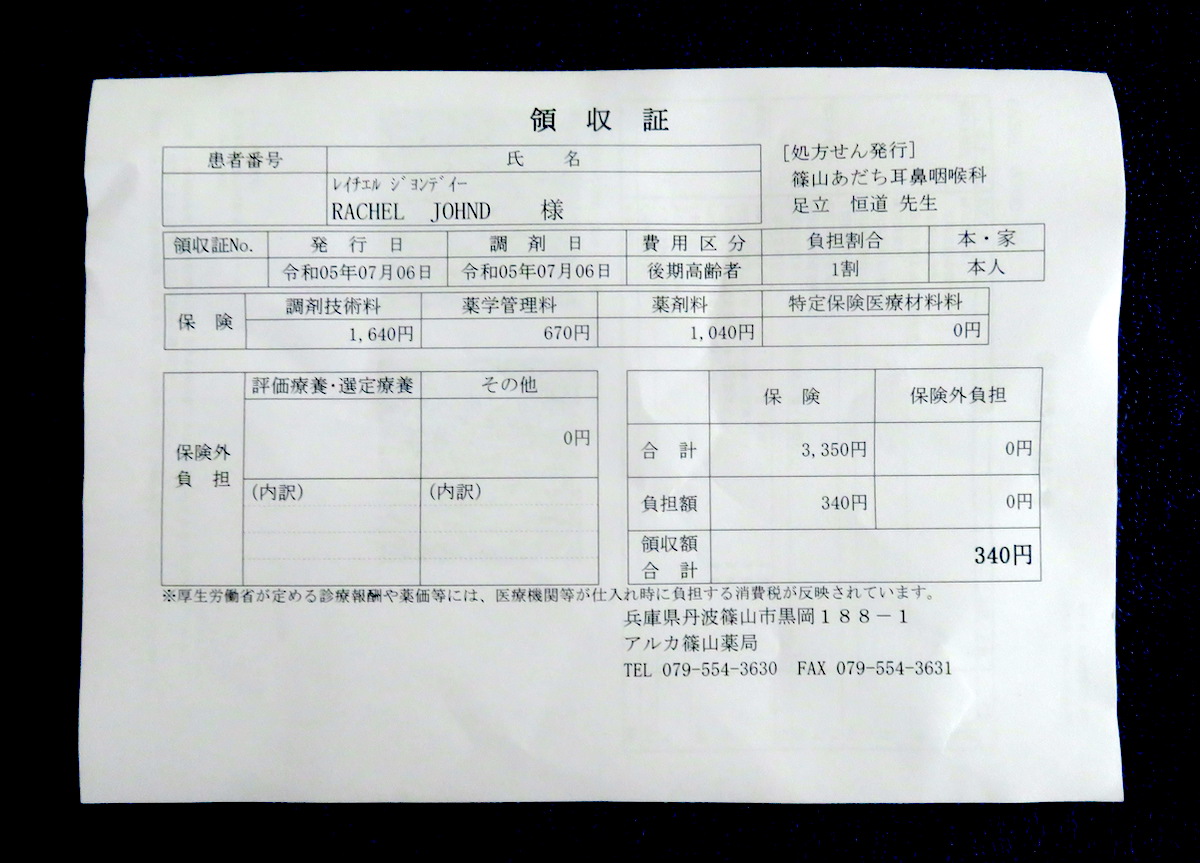
Here are my receipts for the two visits:

According to XE Currency Converter, 1340 yen = $8.55 and 2560 yen = $16.33, meaning the total cost for my new molar crown was $24.88. Of course, I used the “socialized” one-payer national health insurance, as I do for all my medical care.

$24.88 … vs. … $400 to $1200.

Do you think that the bad rap that socialized health care gets in the U.S. — as with anything remotely suggestive of SOCIALISM — might just be a big pile of propaganda, to keep the gravy train of bloated profits for the broken system in America rolling along?

Some time ago, I wrote a similar article about a visit to a local clinic to get a thorough heart examination: Life In Japan: A Morning at the Clinic.

Draw your own conclusions about “socialized medicine”.

______________________________________________________

An entertaining array of similar stories can be yours as a perfect adornment for your coffee table. Live From Japan! is a large-format, full color paperback with 58 anecdotes and over 450 photographs, offering a heart-warming, funny, and informative look at contemporary Japan, through the eyes of an American expat — ME!

A deluxe full-color paperback from the printer HERE.

A deluxe paperback is available from Amazon HERE.

A deluxe full-color paperback is available from B&N HERE.

You can learn more by visiting this website: https://johnrachelauthor.com

Carpe diem!


[ This originated at the author's personal website . . . https://jdrachel.com ]

Life In Japan: A New Crown! | John Rachel


Friday, July 14, 2023

Life In Japan: Prescription Drugs

I’m really curious. So after I tell my tale, I expect some feedback from folks in other parts of the world, especially the U.S.

Very recently I had a relapse. It was a recurrence of something that first happened back in January 2020, when Masumi and I were in Chiang Mai, Thailand. It’s a sore throat from Hell!

The first time it happened, I thought for sure I had throat cancer. A huge lump made it almost impossible to swallow. Incredible pain. I can’t begin to describe what it felt like when the spicy Thai food hit the back of my throat. Think blowtorch and go from there. At least twice, I nearly passed out from the pain.

I didn’t say anything until I got back. We were guests of a very hospitable couple and I didn’t want to worry anyone or spoil the fun.

But the day after our plane landed here, I went to a throat specialist.

It wasn’t cancer. It was a TONSIL! At least part of a tonsil. Infected, inflamed, raising hell.

Now when I grew up, everyone had their tonsils removed at an early age. Standard procedure. I think I was four or five. Anyway, whoever removed mine must have been looking at the nurse across from him because he missed a big chunk. It’s still attached to the wall of my throat, ready to make trouble whenever a cantankerous virus or bacteria enters the scene.

The doctor I saw here was a genius! He diagnosed the problem and prescribed a cocktail of five drugs. I was already mending the next day. If five days, it was as if nothing had ever happened.

I had a recurrence a couple months ago. Same drug combination. Same immediate results.

Last week, I went through the same routine. Now we’re wondering if I should have the partial tonsil removed. We’ll decide next month. Ironically, Masumi and I are going back to Chiang Mai end of this month. We miss the elephants, hillside tribe people, and the night markets. We’re even taking a Thai cooking course this time around. So we’ll wait until we return before thinking about surgery.

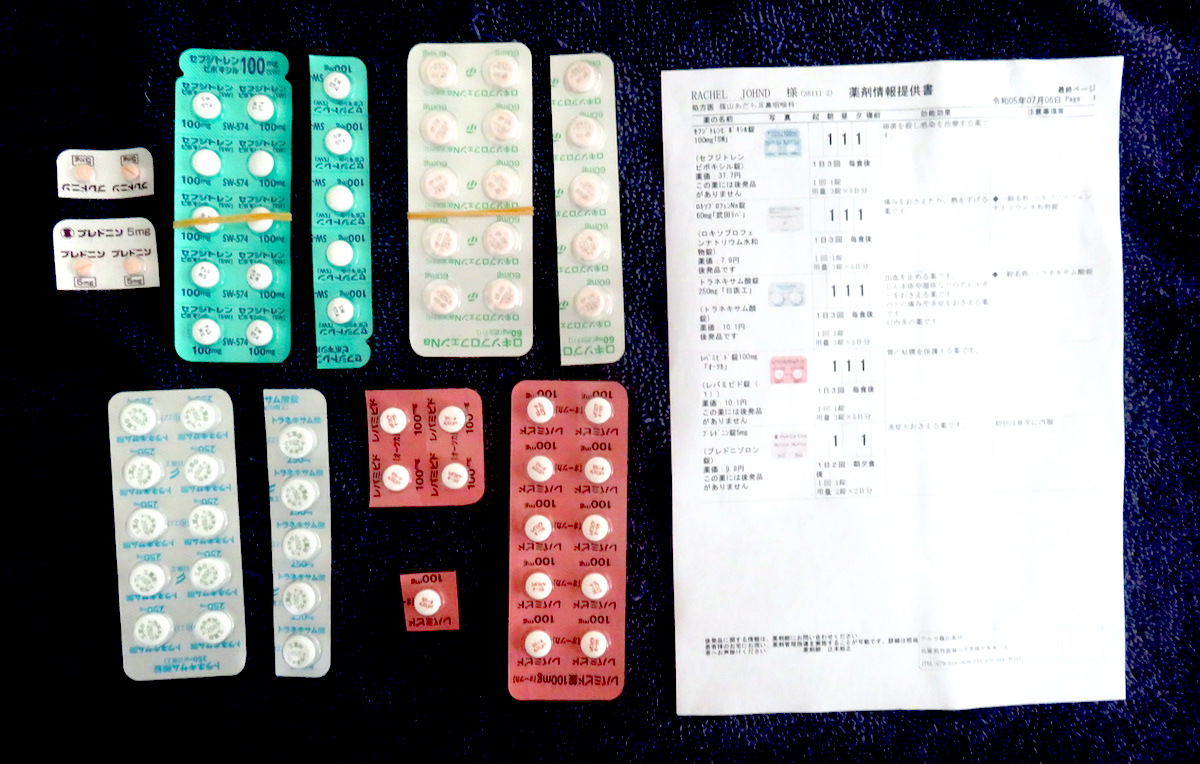
Anyway . . . here’s my question. At the top of this article is a photo of the “drug cocktail,” a 5-day regimen combining powerful, latest generation antibiotics, an anti-inflammatory, a pain killer, and an ulcer-preventative (the anti-inflammatory drug and pain killer can be rough on the lining of the stomach). So there were FIVE drugs in all.

My cost was 480 yen for the entire package. That’s $3.47 USD.

I’m really curious. What would this cost say in the U.S. or Canada?

By the way, the bill for the doctor was even less expensive. 340 yen = $2.46.

I’ve written about health care here before. Obviously I’m very impressed.

So what is it? Socialism? Not really. It’s just a system strictly regulated by the government, which puts people before profits, which values the health of the population over the value of corporate holdings or stocks. Should it be any other way?


[ This originated at the author's personal website . . . https://jdrachel.com ]


Life In Japan: Prescription Drugs | John Rachel


Wednesday, July 13, 2022

“Daddy is a drunk!”

I’ve spent at least ten years talking about “regime change in Washington DC”, trying to explain exactly what that entails, and why it’s necessary for the survival of our nation.

Here’s my last go at it. Daddy is a drunk! It’s an allegory.

Before I start with this heartwarming story about a dad who’s a drunk, let me just make one qualifier. When I advocate regime change in our nation’s capitol, I’m not suggesting a violent revolution. In fact, the idea is to AVOID that, because if there is a violent overthrow of authorities here in the U.S., I have no doubt it will be the bloodiest, most horrifying one in history. We as a citizenry are armed to the teeth, are obsessed with and glorify violence in our myths about ourselves as people and as a nation. Even those who claim to abhor violence seem inexplicably tolerant, with all sorts of rationalizations for never getting serious about eliminating guns or attempting to refashion a culture which is predicated on less adversity, competition, and confrontation. I’m not here to argue any of that. I’m just stating the obvious. If there’s another civil war, it will be a bloodbath.

Regime change, from my perhaps naive perspective — and I do mean total regime change — can be accomplished peacefully, humanely, and legally. But understand what I mean is truly, in fact, without qualification or compromise: REGIME CHANGE. It is removing every single person now holding public office from power and replacing them with qualified public officials who will actually serve the citizens of the country.

Today’s message is directed to the hugely vast majority of fellow citizens, who to my utter and complete astonishment, don’t see any need to replace ALL OF THEM. They don’t see that there are times in life, when things can’t be repaired. Something is so broken, it simply has to be tossed in the trash and replaced.

On to the most touching story you’ll read in the next several minutes.

………………………………………………………………………………………………………………………………….

Daddy Is A Drunk!

Daddy in his twenties was pretty much like most guys his age. He liked to go out and have a good time with his buddies. Have a few beers. Cheer the home team at a sports bar.

When he married mom, they’d occasionally share wine with the meal at a nice restaurant, or even once or twice a month have cocktails with their friends or other young couples.

Twenty years later, daddy was a different human being. The kids were in high school, he worked very hard and since he’d been very successful at his job, he didn’t “hang out” with his personal buddies anymore, but spent a lot of time socializing with colleagues from the corporation he worked at, and VIPs from the international customer base they serviced. Lots of travel now. High pressure and high stakes. But he got paid very well for it.

There was one problem. Now he drank constantly. Morning to night. He literally started the day with two stiff tumblers of bourbon, either of which would put most people on their tushies. Drinks at lunch. Drinks at happy hour. As soon as he arrived at home, he’d pour large glasses of whiskey, drink through dinner, then cap the night off with a few “sweet dreams” shots of liqueur before collapsing in a sloppy stupor on their king-size bed.

Daddy was a drunk.

But it wasn’t just his problem. It was a problem for every member of the family, for the few friends he and mommy still had, sometimes even for neighbors. Like when he drove his new Porsche onto the lawn of the neighbors next door, and wiped out $3000 of their professionally-landscaped lawn and garden.

Daddy had changed from a affable, well-liked, often funny, always entertaining young man into a ego-maniacal, self-possessed, graceless, humorless prick. Oh yes, he could still pour on the charm, even be funny, and in his own self-aggrandizing way be entertaining, nice, sympathetic, affable, whatever the occasion might call for. But the Mr. Fun Guy act would eventually fall apart, and behind the scenes he’d again become Mr. Hyde. Life at home was unbearable. He ranted. He paced. Appeared angry most of the time. Never took any real joy or satisfaction out of being there with his wife and kids.

It was tearing the family apart. Correction. Since this had been going on for three years — it started right when their oldest boy started high school — it had already torn the family apart. There was nothing left to salvage. The kids hated daddy. The wife hated daddy.

Over the three years, there had been five sessions of marriage counseling. Daddy had even agreed on and off to get psychiatric help. At least six times Daddy had been in and out of Alcoholics Anonymous. He’d even been to a hypnotist. Except for very brief periods off the bottle — only days, not weeks — it was the same story. And getting worse by the day.

Within the family — at least at first — they’d talk to daddy, plead with him, try to reason with him. They said all the right things. They thought what they said was persuasive and would make a difference: Daddy, you’re destroying yourself. Daddy, when you drinkyou’re not the same person we know and love . Daddy, we just want to be with you and want what’s best for you. Daddy, you’ll be a much happier person — we’d all be happier — if you stop drinking. Daddy, you’re going to die if you keep this up. Please, daddy!

Through it all, with the rare glimpses of the pain and havoc he was creating in their lives, with a fleeting awareness that he had a serious problem, that he was hurting himself and those he who loved him, daddy would listen and apologize, promise to do better and claim he really appreciated their concern and help. He would do what was best for all of them and quit. Of course, that never happened. After only a few days off the bottle, when he went back, it seemed like he even drank more.

And so the family was — and still is — facing one stark, disheartening, unavoidable reality.

Daddy is a drunk.

Mommy can’t take it anymore. The verbal abuse. No affection. Nothing resembling companionship. No possibility of communication. Nothing could be done to fix things.

It was time for a drastic solution.

Daddy had to go. He had to be removed from the family before he did any more harm.

Mommy filed for and won a divorce. Daddy was gone.

If life was generous, mommy would find another man to love, to love her, and be the father to the kids they deserved.

……………………………………………………………………………………………………………………………….

What’s the moral of the story? Sometimes things get so bad, there’s so much damage and bad history, you have to start all over.

That’s where we are at with our government, with the elected officials now in office, who time and again, over and over, make it clear they do not and will not serve the people who elected them to do just that. They are beholden to their deep-pocketed patrons, both major parties serve the ruling class. The connection between WE THE PEOPLE and those who are chosen — not by us but by the pay-for-play insiders of the Democratic and Republican parties — for us to vote for on election day, exists as a figment of fantasy, the product of very effective and very deceptive messaging. Regardless of what these puppets say during their money-drenched electoral campaigns, they are not on the side of the people.

We can’t take this anymore. We should be mad as hell!

The abuse of power. No loyalty to the voting public. They sidle up to us when they want our votes, then disappear inside the Washington DC bubble. They talk at us. They don’t listen. The iron grip of the rich and powerful on our current elected officials is absolute. There’s no fixing anything with those now in office.

It’s time for drastic action.

These lapdogs of the rich and powerful need to go. They must be removed before they do anymore damage. Examples: More looting of the Treasury to serve Wall Street and the big investment banks. More stalling on climate change, minimum wage, health care, abortion, criminal justice reform, election reform, infrastructure. None of it will get done. What will get done is privatizing social security, more tax breaks for corporations and the rich . . . MORE WAR!

Throw these bums out! You could randomly go through a telephone directory and select names and come up with a better Congress and White House than this circus of clowns who now pose as our national leaders. No . . . I’m not being funny. I’m dead serious!

And you should be too.


[ This originated at the author's personal website . . . https://jdrachel.com ]


“Daddy is a drunk!” | John Rachel


Wednesday, April 15, 2020

Life In Japan: A Morning at the Clinic

The clinics here vary in size. Some are like a doctor’s office. Some are facilities attached to hospitals. When you need medical attention, unless it’s an emergency, you go to a clinic.
I rarely have problems with my health. But I’ve been a permanent resident here now for over eight years, and I have used medical services in Japan a few times. One time a very bad fall from my bike required some very extensive care. I broke my collar bone — I don’t recommend it as it’s very painful — which involved several sessions with an orthopedic doctor and physical therapist. Other occasions were more typical: one time I had an extremely sore throat, another time a kidney infection. Common types of things.
People back in the U.S. are always asking me what it’s like to have universal “socialized” medical care. They’ve been fed all the propaganda by the inefficient but certainly very profitable health care industry there: expect long waits, impersonal care, low standards, lousy doctors, etc. These stories, of course, are generated by the insurance companies, the for-profit clinics and hospitals, the mega-wealthy specialists, rock-star surgeons, all the vested interests who are beneficiaries of the windfall of hard cash that the current system in the U.S. generates for them, and who selfishly but predictably want to keep things the way they are.
I have one story that accurately represents how it works here, straight from my perspective as a patient. Let me say up front, I’m completely blown away by health care in Japan, but I’ll let you judge for yourself the merits of centrally organized and controlled health care.
My wife, Masumi, and I were planning on spending three weeks in the U.S. starting the last week in July. We’d be visiting some of my friends back there, staying at a couple B&Bs, camping at the national parks, even couchsurfing with a retired music teacher in Seattle.
About two months before we were to leave, I started noticing tightness in my chest, and a feeling like my lungs were being compressed. Not a good sign. Red flags immediately went up! What if I have a serious problem while we’re on vacation? I have no health insurance in the United States. And I had serious doubts about the availability of emergency services, based on the stories I regularly hear about the inadequacies and outright failures of health care back in America. Scary!
As the symptoms persisted for a few days, I became certain my discomfort had something to do with my heart. Back in 2010 when I had my back surgery in Seoul, South Korea, they discovered one of my ventricular valves was only functioning at 68% efficiency. Maybe it had fallen apart and was now flapping like bedsheets in a summer breeze!
I decided to take action. The best place for this was a ten-minute bike ride from my house.
Front of Building
Are you ready for my harrowing tale? Because here’s exactly what happens when you have to depend on “socialized” universal health care.
I showed up at 8:45 am with no appointment, bearing a note in Japanese describing my symptoms and suspicions. Twenty minutes later I was interviewed and examined by a heart specialist. He scheduled testing.
Another fifteen to twenty minutes later, I was taken to a special room and wired up for an electrocardiogram. My heart was monitored both as I rested, and as I did “stress testing”. That meant going up and down a small set of steps, which made my heart work harder. The entire procedure took maybe twenty minutes.
I went back to the waiting area for maybe ten or fifteen minutes. Then I was taken into another special room where using ultrasound echocardiography, they observed my heart function in real time, its rhythm, contraction, the operation and efficiency of the valves. This was put on video. After being edited by Stephen Spielberg, scored by Hanz Zimmer, it is now available on Netflix. Okay okay . . . I made up that last part. But the ultrasound of my beating heart was recorded and entered into the system as part of my medical record.
Back to the waiting area. Within no more than thirty minutes, I was escorted back to the office of the heart specialist. He had a printout of my electrocardiogram spread out on the desk before him and was watching my ultrasound as it played on his computer monitor.
Would I need an artificial heart? A transplant? Or maybe it was simply too late!
Actually, my heart was in great shape. The doctor explained there was absolutely nothing that I should be worried about. This, in fact, turned out to be accurate. Whatever the weird symptoms were that I had been experiencing went away after a few days — maybe I’d been eating too many marshmallows or my t-shirts had shrunk — and since then I’ve never had any problems with my heart. Knock on wood, as they say.
Now . . . the part that can often truly give a person a heart attack.
[ Cue dark tremulous scary cello and trombone music. ]
THE BILL FOR MEDICAL SERVICES RENDERED!
Summarizing . . .
At least twenty minutes consultation with a heart specialist. A complete electrocardiogram including a stress test with a nurse. A recorded ultrasonic echocardiography session with a nurse and a technician. I’d been in their clinic for over two hours.
OMG! Will I have to get a job? Get a second mortgage on the cat?
I heard my name called and walked with great trepidation to the payment window and was handed my invoice . . . 3600 yen . . . 3600! THREE THOUSAND SIX HUNDRED YEN!
Why that’s . . . that’s . . . $33.
Unbelievable, eh?
$33 for the entire thing.
No appointment. No waiting. Qualified heart specialist. Comprehensive testing.
$33. No tipping.
Any folks out there who want to offer an estimate of what this would cost in the U.S.?
One last side note on the horrors of socialized medicine. When I tell Japanese people that an ambulance trip in the U.S. can cost $2,000-5,000 . . . they look at me in total shock. Ambulances here are completely free.


[ This originated at the author's personal website . . . https://jdrachel.com ]


Life In Japan: A Morning at the Clinic


Tuesday, August 26, 2014

Negotiating With A Rapist


I get this all of the time . . .

"You're too extreme. Too inflexible. Democracy is about compromise. It's about give and take."

Well, I hate to break it to these weak, waffling ambassadors of abdication: Wake up! There are things which are not up for negotiation. Things which we are so valued, compromise is not possible. Values we don't devalue and mark down at a discount.


An armed thug breaks into your house. He ties you up and has your wife and
13-year old daughter at gunpoint. The thug intends to rape them. You get
to watch.


So . . .

You say to him:  "Listen, I'm opposed to your plans but let's try to work something out. 
How about ..."

You talk it over and come to an agreement on some acceptable amount of rape.

Sound ridiculous? That's because it is.

What's my point?

My point is that there are some things about which we don't negotiate. There are
some situations that are too abusive to the human spirit,
too sick to contemplate,
simply too offensive and just plain wrong, such that compromises __ any
adjustments of degree or intensity __ are not and should never be on
the table. There are policies, value systems, beliefs,
individual acts,
priorities, tactics, strategies, world views, which are so insidious,
trying to find some 'middle ground' is not even a possibility
.
What exactly is an acceptable level of child molesting? Or slavery? How
much torture is just about right? Or to bring up a current horrifying
example, how much beheading nails the
sweet-spot happy-medium for public beheading?

You get the idea.

Yet a lot of heinous acts, criminality, even outright sociopathic and psychopathic
behavior, gets a pass these days, if not the implied imprimatur of our
allegedly ineluctable, shared complicity. It's a pandemic of
wink-and-a-nod fatalism, succumbing to being "practical", surrendering
to the "realities" of our difficult times, or conceding the
inevitabilities of human nature and the practical limits of politics and
social organization.


Talk about a cop-out!

Talk about intellectual laziness!

Talk about moral failure on a national scale!

Talk about failing our society, ourselves and our children!

Who decided that the best possible education for our children was no longer available?

Who decided that the best health care for American citizens was a privilege for the few, rather than a universal right __ as in the constitutional mandate to "promote the general welfare"?

Who decided that healthy drinkable water was not a basic human need, that we'd have to pay for such a "luxury"?

How did America become a nation which imprisons .5% of its population __ the highest incarceration rate in the world __ mostly the poor and people of color?

When did it become acceptable for the wealthy to be above the law and beyond being prosecuted for their crimes?

How did we become a nation which violates the Geneva Conventions, which tortures?

When did America become nation which starves hundreds of thousands of innocent children to make some incomprehensible political point?

When did it become okay for America to be run entirely by corporate oligarchs and ultra-wealthy profiteers?

When did America, allegedly a nation of the people, by the people, and for the people, decide its people should be kept in the dark about what its government is doing?

How did we become a nation which promotes chaos and fear across the globe?

How did we go from democracy to plutocracy in just a few short decades?

When did we as the citizens of the richest country in the world become unwilling to draw a non-negotiable line in the sand on these and other critical issues?

When did we decide that fighting for a decent life for ourselves and future generations was impractical or too much trouble?

The quick answer is that we made little compromises along the way __ bent a bit
here, maybe a bit more there, made some "necessary adjustments", showed
flexibility, and all too often caved in outright when we knew damn well
we shouldn't.


The point is we shouldn't have compromised at all.

Some things should not have been and still are not negotiable.

We need to learn from this pathetic record of equivocation and glib surrender . . .

Enough is enough!

We can't redo the past.

But we can redo our country for the future.

No more than you negotiate with a rapist, you don't negotiate and compromise with those who have proven to be deceptive, self-serving, sometimes malevolent fools who serve the selfish greed of the 1% at the expense of the vast majority of American people.

Most of us know what's right and what needs to be done.

We need to stand our ground.

No apologies.

No excuses.

No fear.


 [ This originated at the author's personal web site . . . http://jdrachel.com ]


Sunday, February 9, 2014

Ship of State


Our ship of state cannot find a new, better direction by rearranging the deck
chairs, hiring a new trumpet player for the band in the Captain's
Lounge, or repainting the life boats.


It really comes down to setting an entirely new course, even turning the ship 180º
around if it's heading entirely in the wrong direction. Nothing less will get the job done.


Yet, our often bitter national conversation __ sometimes a shrill shouting match
__ is always focused on the tiniest details, irrelevant details which
serves both to distract us and obscure the larger issues which are the
real source of our national conundrum and chronic paralysis. Whether
this is intentional or not, it has poisoned all of the air in the room
and killed progress on the many critical __ as in life-or-death __
challenges confronting us.


We argue about capping student loan percentages and whether bankruptcy 
should be allowed for individuals who can't pay for their student loans. 
Public funding for advanced education has been coming up short both at 
the national and local level. Public universities facing insolvency are
either depending more on private __ as in corporate __ funding, or being
completely privatized. Tuition is shooting through the roof. To assure
profitability, institutions of learning are becoming more beholden to
private industry. The disturbing upshot of these trends is that higher
education is becoming unaffordable for the majority of young people, 

at a time when employers are demanding even more education of their
prospective employees. Nevertheless, all we seem capable of doing is
nitpicking away about the burgeoning student debt problem.


The real question is what kind of country doesn't educate its population?
Conservatives say the money isn't there. Yet we spend in the upwards of
$1 trillion a year __ that's trillion with a 't' __ on our military. We
really need to ask: Books or bombs?


We argue about the upsides and downsides of Obamacare, wrangle over
the exemptions and loopholes in the program, condemn governors who
are opting out certain aspects of the Affordable Healthcare Act. These 

are certainly genuine issues but not the problem.


The real problem is twofold: There is nothing keeping the cost of health care
under control __ we spend 17.7% of our GDP on health care, next closest
are Holland at 11.9%, France at 11.6%, Germany at 11.3%, Canada at
11.2%,  __ and much of what we spend on services is turned into
corporate profits. You get sick, corporations make money. The sicker you
get, the more money they make. Am I off here but isn't there something
bizarre or even cruel about turning human misery into an ATM machine?


So forget the details of this sub-clause and that policy rider. We need to 
address a very fundamental question about what kind of society we want. 
Is America a country where the proper care and health of its citizens is a
fundamental and integral part of "the general welfare" __ is a basic
right __ or is it a service commodity like getting your car tuned or
your house painted? There is no other modern industrialized nation 

which does not lean toward seeing health care as a right, like voting, free
speech, freedom of religion, and so on. America distinguishes itself by
ignoring this most fundamental aspect of life, liberty, and the pursuit
of happiness. Only in America will you be left to die just because your
insurance doesn't cover your problem or like 40 million others you have
no health insurance.


We talk about whether we should go to war with Syria or Iran, whether 
we should continue to use drones, what we can do about North Korea. 
Yes, this is a dangerous world. But we ignore a simple fact. We are the 
ones making the world a more dangerous place. We are now viewed by 
the rest of the world as the greatest threat to peace and stability on the planet. 
With maybe a few obvious exceptions, we are the problem, not those we are 
constantly demonizing. We are becoming a pariah in the world community.


Because of the wholesale takeover by the military-industrial complex of our
foreign policy apparatus, meaning wholesale embracing of a 

neocon imperialistic world view, we don't even consider peace as an option. 
We don't work for peace. We don't think about peace. We rarely mention peace. 
The military option, from targeted drone bombing to full-scale war is apparently 
the only option. We have a one-size-fits-all strategy: Bomb, kill, destroy.


The real question is:  Do most American citizens want America to rule the
world by force?  Do the imperial ambitions and delusions of global hegemony
of our leaders truly reflect the values of the majority of our citizens?
What insanity is Washington DC championing here on our behalf?


Who's version of America arms the world __ we are the biggest arms supplier
on the planet __ antagonizes every other world power, bullies its friends and foes 

alike, never takes 'yes' for an answer unless it's a 'yes' for armed confrontation, 
and expects to survive?


This is a survival issue. Because if any significant number of the countries
becoming increasingly fed up with America's my-way-or-the-highway
tactics unite, no amount of bombs and bullets will rescue us. Think
about this: America hasn't won a war since WWII. Oh right . . . forgot. 

There was Grenada. A country of with less than 1/4 million people with 
no standing army. We trounced them.


Then as we spend about as much on the rest of the world combined on our 
vast military machine, we scream and yell __ perhaps rightfully so __ about
our national debt, about both our personal and public indebtedness,
about home mortgages, foreclosures, credit card debt, of course, again
student loan debt, how much we owe China and Japan, etc. Sure these are
important matters. But they are only the dirty wine glasses on the
Titanic.


Because the real question is:  Why doesn't the nation we pay our hard-earned
taxes to have control of its own currency? Why don't we as Americans
have any say whatever in the way the money of the richest country in the
world is handled by its central banking institution, the Federal Reserve? 

The Federal Reserve is not federal __ meaning a part of the federal 
government __ any more than Federal Express. It is a privately
owned-and-operated corporation! Our currency is not issued by Uncle
Sam. It's issued by Uncle Ben, as in Ben Bernanke! How can we get our
budget priorities in line when we don't have any control over the very
currency we use? This sounds on the surface like some abstract question
but it is fundamental to creating a sound economic system. He who
controls the purse strings controls the world.


And now is the really big one, which spawns all of the others. This is the 
big daddy sitting at the top of this shit pile of self-deception causing all
of the yelling, blather, incoherence, gridlock, confusion, frustration,
helplessness __ the ultimate bargain with the Devil.


We argue about Republican vs. Democrat, conservative vs. liberal, we 
have our standing jokes about Libertarians and spoiler candidates from 
the Green Party, and we point at the ultimate lepers of our time, socialists!


But the simple truth is that it's not about Democrat vs. Republican. It's about
tyranny. The tyranny we have invited by our apathy and our self-invoked
declaration of surrender. The tyranny that marches in when hope is
replaced by hopelessness and
toughness traded out for submission and 
compliance. It's the tyranny of the power elite that fills the vacuum of 
citizen engagement and self-rule. It's the tyranny of rule by a tiny core 
of elite oligarchs when voting becomes an exercise in futility, if not a 
complete joke.


All of this contentiousness, bickering, in-fighting, out-fighting,
cage-fighting is irrelevant. Because we don't have representative
government anymore.


DEMOCRACY IN AMERICA IS DEAD!


Now that's the real issue.


And until we address that issue, nothing else will get done. Politics will be
a board game, about as relevant to governing our nation as Monopoly is to
the real economy.


The evidence for this is clear.


No matter who is in power, Democrat or Republican, most everything 
just gets worse.


Ralph Nader made the controversial claim in his 2000 campaign for 
president that the two parties were Tweedle-dee and Tweedle-dum. That 
was both perceptive and prescient. Now in the coming mid-term and 2016 
elections, it is even more the case than ever. Real choice within the two-party
system is an illusion. Third party and other independent candidates are
almost totally shut out, shouted down, or mocked by those who benefit
from having a two-party system beholden to the corporate aristocracy.


So the questions we need to address here are not the hot issues of the day. 
The questions are practically never what is being discussed in the 24/7/365
tsunami of scandal, rumor, manufactured crisis, and drama queen reporting
that passes for news these days.


The most important question is whether we can become a functioning 
democracy again.


Whether a Democrat or a Republican supports gay marriage or gun control
or legalization of marijuana may seem like life-or-death issues. This is
what we constantly hear from both media pundits and politicians alike.
But these issues __ these "details" __ pale against the real question,
the big question.


Do these men and women in suits __ Democrats and Republicans __ 
support America?


Do they support America, or is their true loyalty to the huge transnational
corporations which are looting our treasury via corporate welfare and
off-shoring their profits, turning our country in a big wasteland devoid
of real opportunities for real Americans, trashing the environment, and
bankrupting our political system by buying our elected representatives?


So what's the point of all of this?


It's very simple . . .


We can wring our hands, fret and ponder about the minutiae. But until we 
fix the big problems, nothing will get resolved. Our educational system is
rigged. Our health care system is rigged. Our foreign policy is rigged.
Our tax system is rigged. Our monetary system is rigged. Our democracy 

is rigged. So . . .


We can sweat the small stuff but all we will end up doing is standing in a puddle
of sweat.


I talked about this problem of scale __ the big fundamental systemic issues vs.
the narrow typically charged and highly divisive ones __ quite some time
ago in a previous blog called "
You Don't Use A Microscope To Find The Cow
You Don't Use A Microscope To Find The Cow That Left The Barn".
I also discussed the epic levels of exaggeration which issues from our
government institutions supported by the talking puppets in the media,
essentially propaganda designed to convince the public that the
dysfunctional 
blowhards we elect to public office are actually getting something done. 
That blog was called "Differences That Don't Make A Difference".


Back then __ respectively April and March 2011 __ neither seemed to make 
much of an impression. But considering it's been almost three years now and 
things are just getting worse, maybe this would be a good time to revisit them.


As to the important business of steering the ship of state . . .


Maybe it's time for a mutiny.


[ This originated at the author's personal web site . . . http://jdrachel.com ]