Since leaving America August 2006, I have traveled to sixteen countries. A great deal has happened. This site is to share my thoughts, photos, music, writings, travel experiences, and developing political/social commentary with you. I hope you find it interesting and informative.
However, in 1951 Daihachi Oguchi, a jazz-trained musician based in Nagano Prefecture, transcribed into modern notation several traditional Taiko pieces, adding his own touches. He formed his own ensemble — Osuwa Diako — and performed these modernized works. The new performance style, known as kumi-daiko, quickly grew in popularity, and soon many other ensembles formed and continued to popularize the musical form.
Taiko performances are common both in Japan and other parts of the world. We recently had such a performance at the castle grounds located in the heart of downtown Tambasasayama.
As a songwriter/music producer, I love taiko music! There’s the drama of the choreographed drumming making a riveting visual statement. But it’s the power and energy of the layered rhythms which most captivate me. The first layer is the towering tribal warrior beat which drives the entire performance. On top of that and weaved throughout are some very interesting counter rhythms. It’s impossible to stand still and not smile at one of these performances.
Hey! You want to really surprise your friends? Hire one of these taiko groups for your next birthday or anniversary party. A good time is guaranteed for all!
And you might make a new friend . . . like we did.
Anyone familiar with Masumi knows she’s a teacher, specifically a music teacher of elementary students at a school in Inagawa, a medium-size town less than an hour from Tambasasayama.
But like many — most? — Japanese people, she is always finding ways to improve herself. This includes periodically taking courses and training to increase her teaching, her ongoing study of English, her studies and activism in human rights and peace, and of course improving our seasonal efforts to grow a variety of vegetables. Just yesterday, we harvested our potato crop!
But despite more than thirty years teaching kids both how to play and how to appreciate music, she is also still improving her “chops” at learning and performing music. She is already a marvelous piano player and singer, and regularly takes ballet classes.
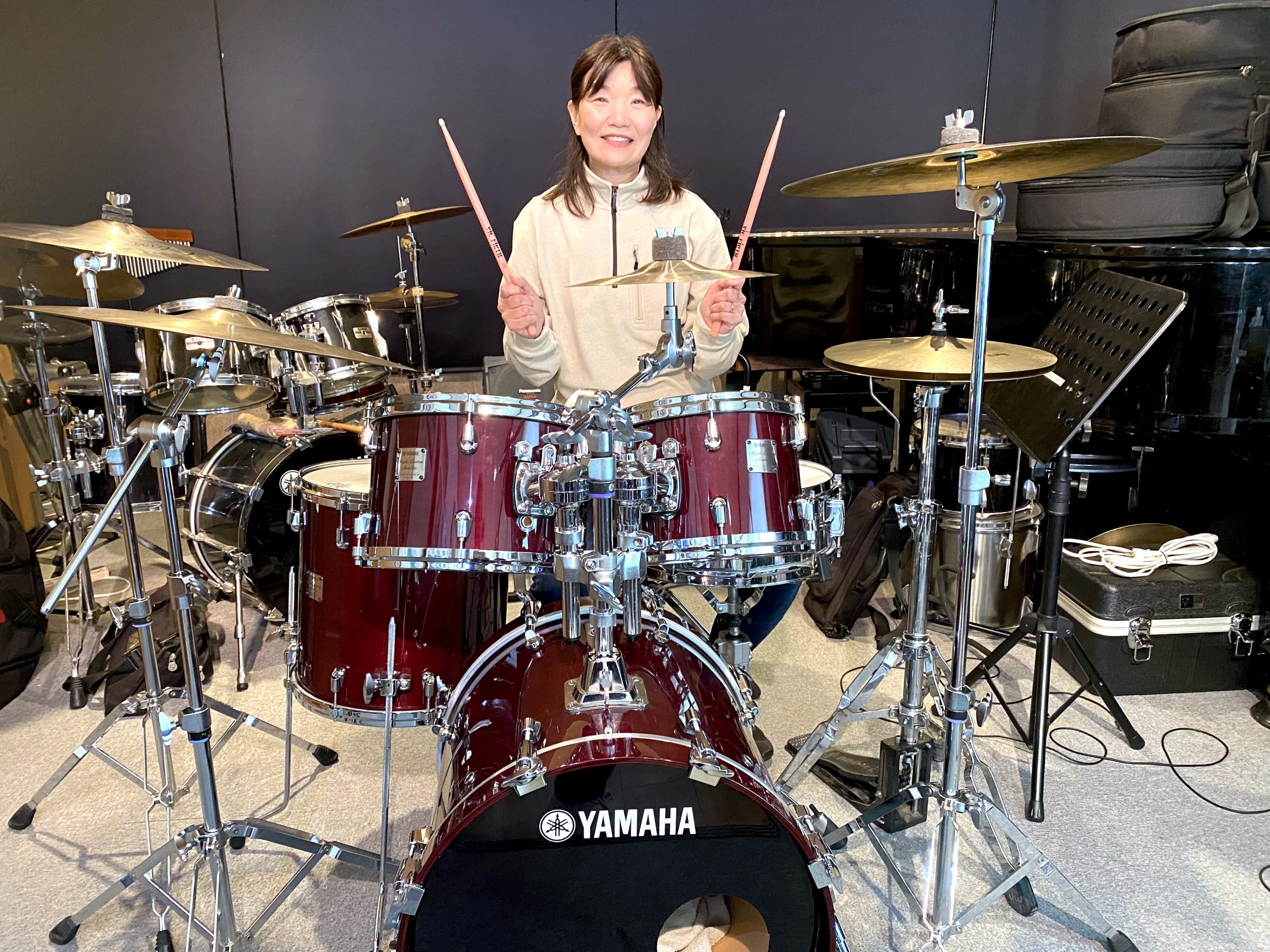
Now, much to my surprise and genuine delight, she is dedicating much time and energy to learning to play cello and — see above — DRUMS!
Masumi has a top-of-the-line Roland V-Drums electronic kit set up here at home, which allows her to practice daily without disturbing me or the neighbors. While on headphones, she gets the full effect of the drum fury she creates, we on the “outside” only hear the light pitter-patter of drumsticks on rubber pads.
The photo at the head of this article was taken at her first drum recital last year. For this live show, she played on a real drum kit, performing Stevie Wonder’s Knocks Me Off My Feet.
This year, at my suggestion I might add, she’s performing Vanessa Carlton’s Thousand Miles. I’m really looking forward to it! This is one of my all-time favorite songs. It’s so completely original, combining classical and pop, a phenomenal production and vocal performance. It has a nicely-grooving drum part, uniquely incorporating syncopated snare hits during the chorus, a highly unusual choice for a pop song.
Most of all . . . I get to see the fruits of Masumi’s many hours practicing drums! It should be great fun.
I continue to be amazed at the level of education here in Japan. While test scores are falling in the West, those here and in China continue to rise.
Most concern about academic performance focuses on math and reading ability, but since my wife, Masumi, is a music teacher, I get to take a close look at music education. Schools here consider music an important part of overall development, realization of full human potential. I’m always astonished at what Masumi gets her students to do, culminating in a concert each year, attended by proud parents. Though she teaches 2nd through 6th grade, the musical pieces the kids master are by any stretch not simple.
It starts as soon as the kids arrive at school. Kindergarten is two years here, for four and five year olds. The following videos are from a school in Tokyo. We’ll start with a performance by five-year-old Kindergarteners.
Pretty amazing, eh? If that didn’t blow your mind, here are FOUR-YEAR-OLD kindergarteners from the same school.
Finally, here are students at all levels, Kindergarten through 6th grade of the same elementary school, performing an excerpt from Beethoven’s 9th Symphony.
Kids love to be challenged. A big part of confidence and self-esteem comes from improvement and a real sense of accomplishment. I wonder if kids in the West are over-pampered and their egos shielded from the horrors of failure, at the expense of ever attempting and achieving excellence. Just a thought that occurs to me when I see what’s happening the public education in America.
I’ve always considered myself out on the fringe, cutting edge, pushing the envelope. Life is more interesting that way. But this time I pushed things too far.
A few months ago I jumped feet first into a new music project. Bunny Yō is a Q-pop star, unlike any I’ve ever worked with before, unlike anything out there these days. I won’t try to describe her. Just go to the website and try to figure it out for yourselves.
It has not been going smoothly at all. I love the music. I especially love the attitude, because it’s so weird and irreverent. But apparently no one else gets it, at least so far. Bunny’s first single, Orphan Sex Club, has been banned on TikTok. Most of the song’s YouTube videos have been age restricted, which is ridiculous. There’s nothing obscene about any of it. The censors fail to appreciate that it’s a joke. Orphan Sex Club? Come on! Get a sense of humor!
But that was just for starters.
Let me explain something. Bunny is in no position to do any of the technical stuff, none of the promotion, nothing but what she does. So yours truly has been handling everything. I put together the website, designed all the Bunny Yō accessories — t-shirts, truckers caps, coffee mugs — building everything around the Bunny Yō persona, lyrics, music, imagery, doing my best to capture and be faithful to her vision.
Well . . . this t-shirt was where the real trouble began.
Apparently, it caught the attention of some woke bloke and his indignation and gut rage spread through the woke community like monkeypox. They looked at the entire Bunny Yō project and for some reason thought I was making fun of them.
Let me tell you something. As J. K. Rowling will attest, you don’t want to mess with these people. There’s no reasoning with them. They’re like a mob of rabid witch hunters!
Anyway, here I am. In a jail cell of my own creation, waiting for the verdict.
Things don’t look good. My attorney (pictured on the right) apparently studied law at an auto mechanics trade school in Moldova. She raised no objections when a motion was entered — and approved by the court — to skip the trial and just let the jury decide on my guilt or innocence. I still don’t know what I am charged with. No matter who I ask, they just roll their eyes and sneer at me like I’m a big festering sore on the butt of humanity.
Whether you like, love or hate classical music, please watch at least one of the videos below. I have things to say about them which I think will astonish you. So fasten your seat belts, sit back, and let the music flow through you like cannabis oil aroma therapy.
Okay. Ready? Here’s the scoop …
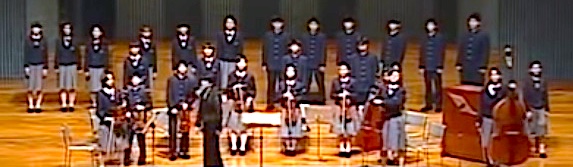
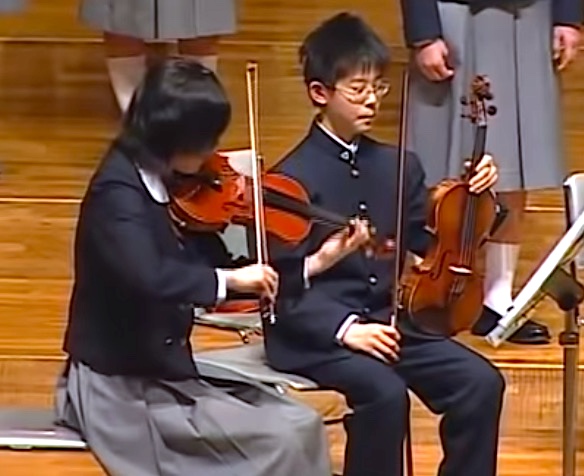
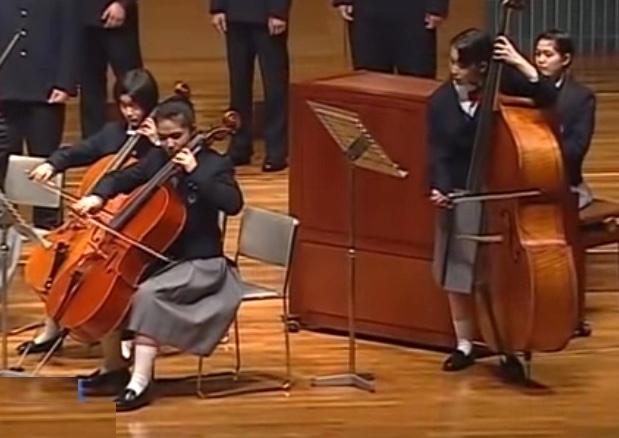
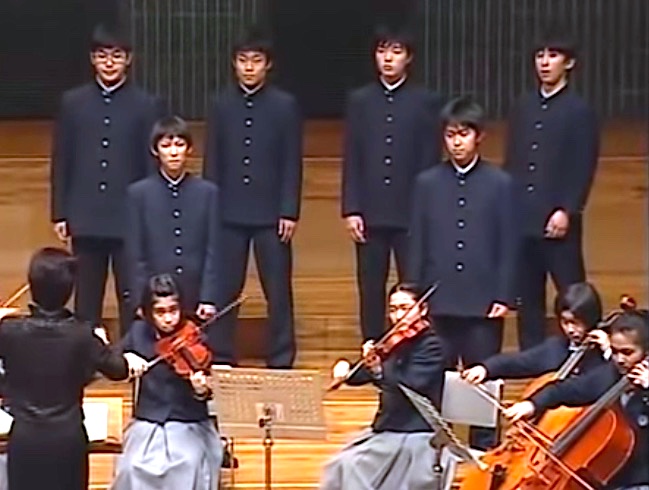
These are junior high school students, at a school in Fukushima. Yes, that Fukushima, where the massive earthquake in 2011 caused the nuclear reactors to melt down. But that’s not what I’m here to talk about.
Instead, let me get to what I want you good folks to wrap your heads around. First …
Being junior high school students, everyone except the conductor is 13-15 years old. Not seasoned adults. Not college graduates. Young adolescents! What talent, eh?
It gets better: This is not a special school for music or any other area of study. It’s not some private school for rich kids — yes, we have exclusive, private schools here in Japan just like practically every other developed country. This particular school is no such uppity institution. No folks . . . THIS IS A PUBLIC SCHOOL!
And here is, what in my mind is the most jaw-dropping aspect of this tale: Participating in this choral orchestra is not part of the official school curriculum. This is not a music class. The students are not getting any credit for this. Everything, the individual mastering of the instruments, the hours of practice, the orchestra and vocal rehearsals, the concert performance, is purely voluntary. It’s an AFTER-SCHOOL CLUB!
I recall my school had a French Club, Photography Club, a Glee Club, an Astronomy Club. It’s just like that. Only these junior high kids, as members of this club, are performing — at a sophisticated level — Mozart and Bach.
What do you think? Honestly? Aren’t you a bit impressed?
I have to admit: I’m awestruck! Almost at a loss for words . . . but not quite.
Here are my final thoughts: The world is going through some very strange and difficult times. Technology, political turmoil, economic crises, environmental crises, leadership crises. We can’t keep up with it all. Unfortunately, young people get totally blindsided by all of this. They’re dropped into a world not of their making, facing catastrophes that were in the works before they were in the womb. Supposedly, societies do what they can to bring the young up to speed and equip them to take the reins when their time comes.
U.S. schools are a more relaxed educational environment.
Here are my final thoughts: The world is going through some very strange and difficult times. Technology, political turmoil, economic crises, environmental crises, leadership crises. We can’t keep up with it all. Unfortunately, young people get totally blindsided by all of this. They’re dropped into a world not of their making, facing catastrophes that were in the works before they were in the womb.
Supposedly, societies do what they can to bring the young up to speed and equip them to take the reins when their time comes. In the U.S., as with every highly-developed Western nation, it is the public education system which provides the basic skills and knowledge needed to function in the world.
Now, I’m hardly in a position to judge the current state of public schools in the U.S., which by far the majority of young people there attend for 12+ years at minimum. True, I went to public school for 6 years but that was around 200 years ago, give or take a few decades. Moreover, as you probably know, I haven’t lived in the U.S. for sixteen years. Meaning, I can’t overcome either the generational gap or the geographical gap. So I’ll let you folks be my eyes and ears on this.
Here’s a straightforward question for you American readers: How are things going there?
Is anything resembling what you see in the above videos occurring there?
I know I have trouble imagining it. But that’s just me.





I continue to be amazed at the level of education here in Japan. While test scores are falling in the West, those here and in China continue to rise.
Most concern about academic performance focuses on math and reading ability, but since my wife, Masumi, is a music teacher, I get to take a close look at music education. Schools here consider music an important part of overall development, realization of full human potential. I’m always astonished at what Masumi gets her students to do, culminating in a concert each year, attended by proud parents. Though she teaches 2nd through 6th grade, the musical pieces the kids master are by any stretch not simple.
It starts as soon as the kids arrive at school. Kindergarten is two years here, for four and five year olds. The following videos are from a school in Tokyo. We’ll start with a performance by five-year-old Kindergarteners.
Pretty amazing, eh? If that didn’t blow your mind, here are FOUR-YEAR-OLD kindergarteners from the same school.