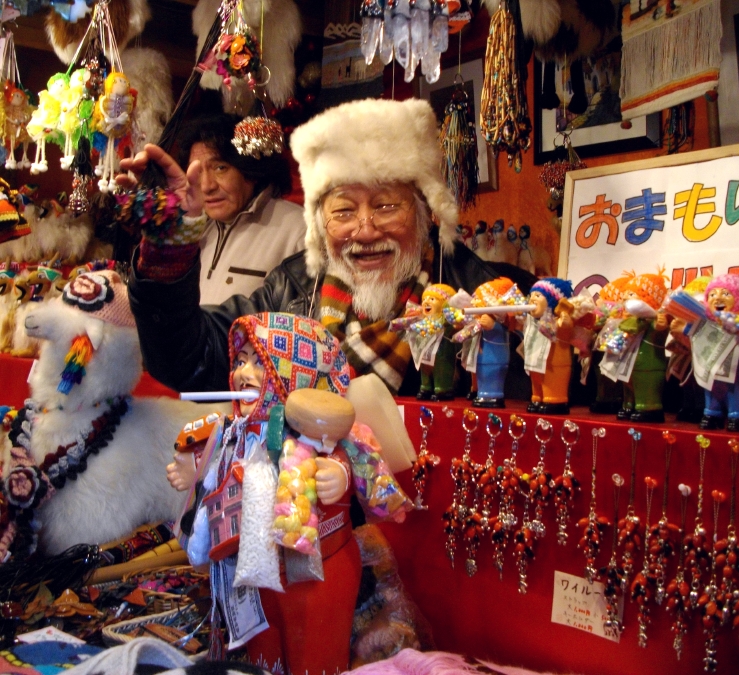
I admit, at first I had mixed feelings when I encountered Western holidays in Asia. Wasn't it cultural pollution? Wasn't any place safe from Ken and Barbie dolls, the Easter Bunny, Superman, Santa Claus, Ronald McDonald, Taylor Swift? Was Western capitalism going to turn the entire surface of the planet into a Universal Studios City Walk?
Gradually, however, I've adjusted to the fact that in Asia, Japan in particular, the modus operandi tends to be a sponge more than a condom. The cultural roots here are so deep, a little cross-pollination in fact reinforces the uniqueness of the region's distinctive features.
Besides, Japanese are a bit selective, tending to embrace the funner holidays, with a clear preference for those which can be commercially exploited.
That brings into the fold Christmas, Father's Day, Mother's Day, Easter, Valentines Day -- which I've written about in another article as well as its enhancement with the addition of White Day -- and Halloween.
Japanese already exchange gifts at a frenzied pace. It's considered rude and unacceptable to visit anyone without bringing a gift. It's not just social visits. I had a lady almost drive into me when I was riding my bicycle. She barely brushed against my pant leg with her car and I just laughed, smiled and waved, then rode off. She actually took the trouble to track down "the American" and the next day showed up at my house with an interesting present -- it was a bag of fresh eggplants and a note.
As you'd then expect, all of the Western holidays are celebrated with gifts, maybe holiday cards. But that's it. They don't shut down the stores and banks. There are no Halloween or Easter parades. To alert the buying public about these holidays, decorations come out, appropriate to the occasion. There might be some posters in the windows of a store, and special products display. At Christmas in our traditional rural town, there are a few large coniferous trees decorated with Christmas lights. For Halloween candy is put out on sale, as much as six weeks in advance. But the reality is, these holidays are entirely low key affairs, certainly not the extravagant spectacles we often experience in the West.
Let me qualify that slightly for a some locales other than Japan. In Ho Chi Minh City (Saigon) Vietnam, for the month of December, the whole town goes into a Christmas frenzy. Tons of decorations, tinsel and gaudy trees, fake snow, fake snowmen -- is that PC? maybe it should be snowpersons -- and Santa's helpers (usually cute girls) running around handing out advertising fliers. And then there's Bangkok, Thailand, which gives Ho Chi Minh City a run for its money -- literally, as it's entirely about sell sell sell -- for Christmas hoopla.

Having said all of this, I will confess that I can't suppress the allergic reaction I get when I walk into a Japanese supermarket, restaurant, mall during November and December and am subjected to the Christmas carols I typically heard back home in my homeland of birth, holiday songs which cumulatively I've heard at least 100 million times. Maybe more!
The problem for me mostly is the schizophrenia of contemporary Christmas. Or maybe a better way to characterize it here in Asia is the "disconnect".
The schizophrenia infects the U.S. and Canada. What was once a fairly sacred holiday celebration has over the years become an orgy of consumer excess, with brawls and fist fights breaking out over Christmas sale items at Wallmart and other stores.
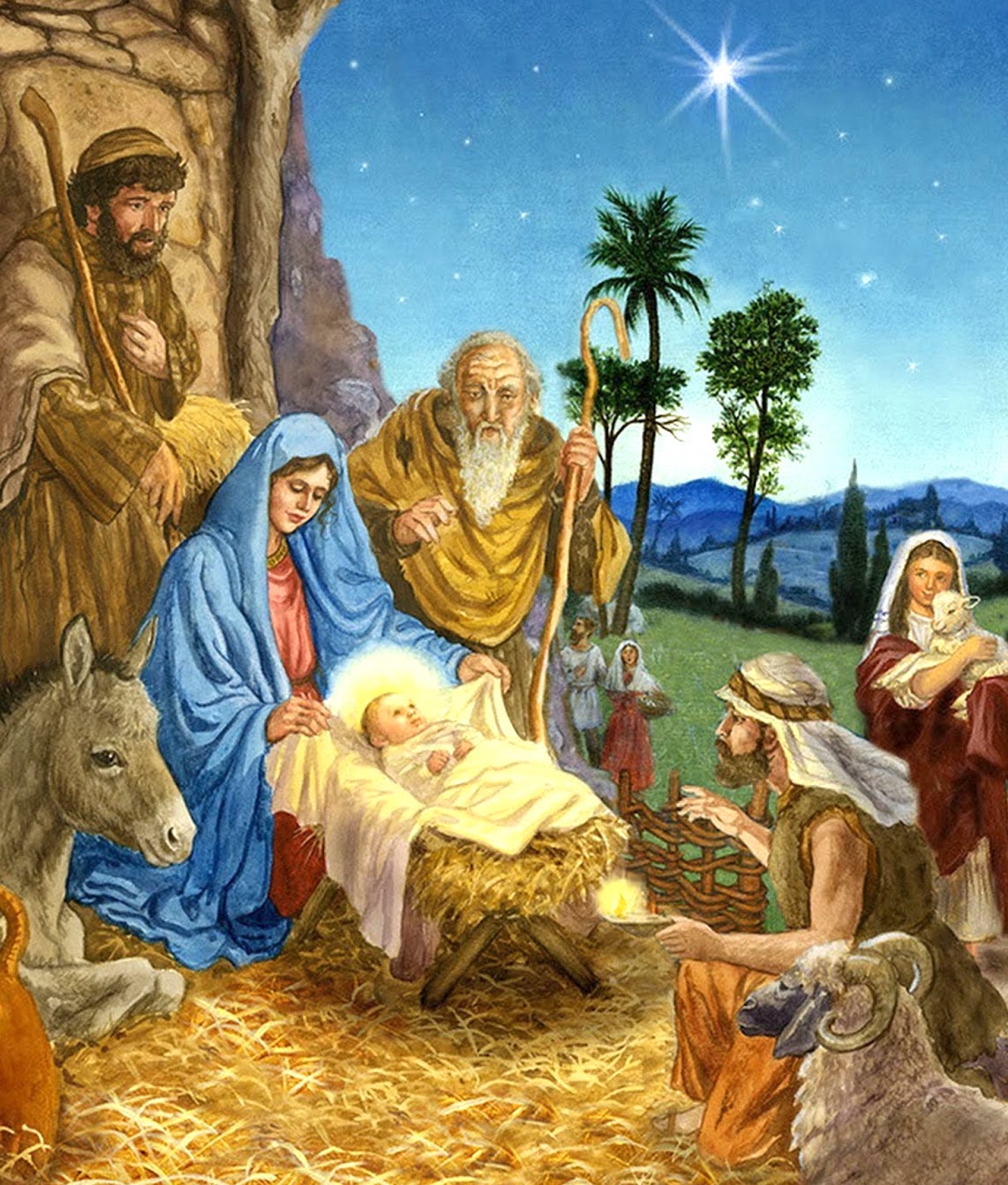 Not that the religious version holiday itself didn't have some problems. Stepping back from the official story a bit, it all seems rather unsavory and unlikely. Virgin wife and her presumably sexually-frustrated but stoic husband are traveling. Failing to have access to Trip Advisor or a good travel agent, they can't get a room. To complicate matters, she's pregnant by God, creator of the entire Universe. Why did the creator of the Universe choose this particular lady in the first place? Virginity was "the thing" back then and God certainly had His pick. Anyway, she goes into labor so they decide to hole up in a manger. Talk about unsanitary! Cow and goat poop everywhere. The potential for very serious infection is high. But no worries. She spits out the Son of God under these inauspicious circumstances. Giving birth was that much of a breeze back then that a carpenter -- her patient and enduring husband -- was able to pull this off. With carpenter's tools? What did they do with the afterbirth? Being part-and-parcel of the birth of the Son of God, it seems it would have some sentimental value. Then after the birth, three wise men show up, guided to the mangy manger by a heavenly object we presume wasn't a helicopter. They just happen to know the Son of God, halo in place and in full view would be there, thus they brought appropriate gifts to celebrate the special occasion.
The result is that among the enormous piles of "stuff" people shop for starting on Black Friday -- how weird a name is that, for Christ's sake? -- are Nativity scenes. I guess that makes maxing out credit cards more of a sacred, heavenly-endorsed exercise.
Some folks erect huge, expensive, gaudy Nativity scenes on their front lawns.
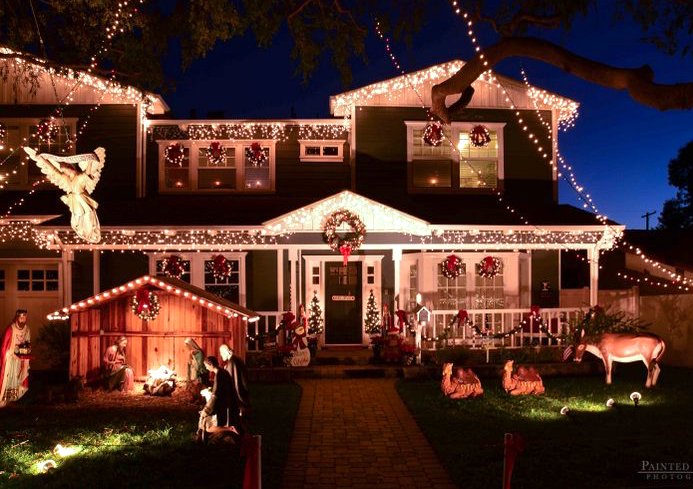
(Rumor has it that Jeff Bezos has live humans in his Nativity scene. They're, of course, given occasional bathroom breaks and the chance to run down to 7-11 to buy food. Their families are allowed fifteen minutes on Christmas Eve to visit them as long as they don't attempt to cross the electric fence surrounding the charming, real-life action portrayal of the birth of Jesus. This is, of course, just a rumor, one I'm starting right here, because the beauty of the internet is that you can say what ever you want and people will usually not question it.)
Anyway, what was considered over the centuries by Christians as a defining moment in time, inaugurating for eternity a new era for all that is and will be -- the birth of the Savior of Humankind -- has in the U.S. mutated into the most defining moment each year for the consumer economy. Around 1.9 billion Christmas cards are sent out annually and the average person does 25% of all their discretionary spending during the holiday, even though it's questionable how much discretion they show.
Christmas is less schizo and for me here in Japan, as I mentioned, more of a 'disconnect'. Being a Buddhist and Shinto country, there is no attention paid to the virgin birth and the epic arrival of Jesus on Planet Earth. It's strictly a commercial enterprise, though not on the scale of the U.S. and many other Western countries. It's an excuse to buy stuff and give gifts with pretty wrapping.
It's also an excuse to eat fried chicken! Yes . . . fried chicken.
In a stroke of marketing genius, several decades ago KFC embarked on a campaign to convince the Japanese that fried chicken was the preferred meal at Christmas in the U.S. No one apparently bothered to ask any Americans or they would have found out that it's either turkey or ham at Christmas and no one in their right mind would eat fried chicken.
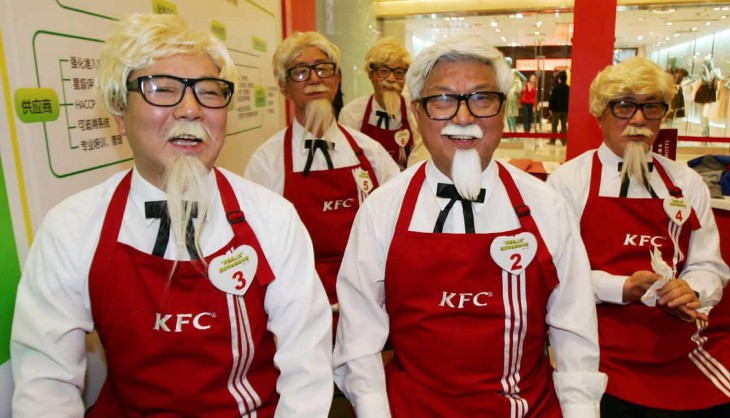
The campaign worked and now people place orders with KFC, of course, sometimes as far ahead as a month in advance -- can't risk having no fried chicken on December 25th -- for buckets of the Colonel's unique blend of herbs and spices. Honestly, it's such a novel idea, this year I may try it myself. Why not? How does the expression go?
When in Tokyo do as the Tokyoans!
Something like that.
One recurring incident which never fails to amuse me is when people who should know better -- friends who know I live in Japan, not in the U.S. -- ask me something like . . .
"How was your Thanksgiving?"
Now I'm not an expert on Japanese history, but I feel safe in saying that in spite of the fact that navigation was touch-and-go back then, the Pilgrims never made a stop here. And if they had, they wouldn't have had fried chicken for their welcoming banquet with the local folks. Maybe sea cucumbers? Or sashimi?
For related reasons, the Japanese don't celebrate Independence Day, Memorial Day, or Martin Luther King Day.
So don't ask.
[ This originated at the author's website . . . https://jdrachel.com ]
Life In Japan: Western Holidays