Showing posts with label Japanese traditions. Show all posts

Thursday, August 8, 2024

LIVE FROM JAPAN! Revisited Redux

I again want to send some love to the wonderful fans of LIVE FROM JAPAN!

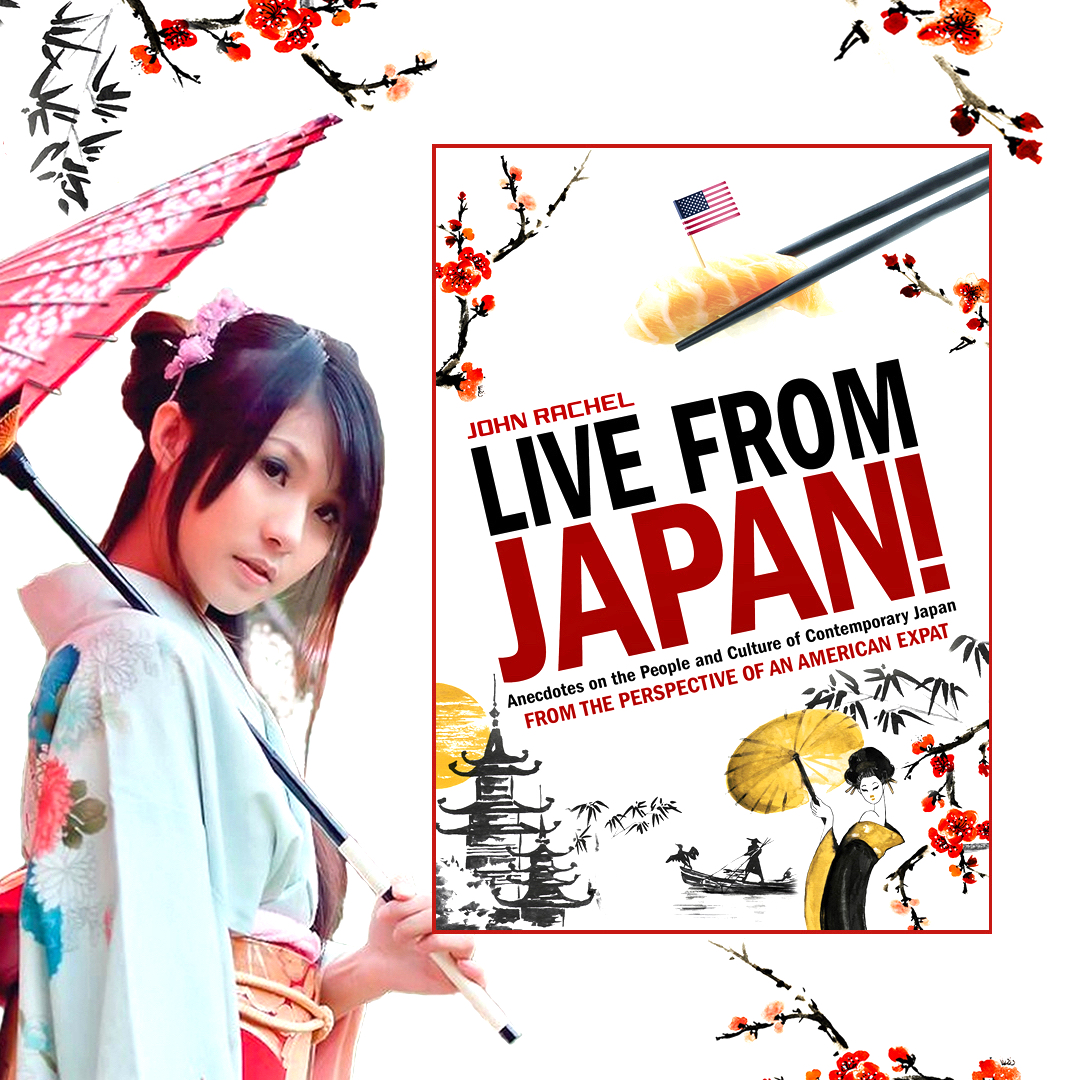
My my how time flies! LIVE FROM JAPAN! was published end of January, 2021. I sent the first shot of love here to the fans of the book June 2023. Then, as now, I let everyone know that the saga continues, as I regularly post articles on new happenings and my evolving perspective on life here as an American expat.

While I believe my understanding of and appreciation for the customs and people of Japan is always growing in depth and subtlety, one thing has not changed: I love living here!

There’s no simple explanation for this. All I can suggest is read my book, then read the articles that have subsequently appeared. Judge for yourself..

Here is the entire list of “living in Japan” essays that have appeared on this website, to date:

All of those were written after this splendid book got published. My way of keeping you up to date and hopefully dazzled and delighted.
If you don’t have a copy, you have no idea what you’re missing. Time to remedy that. You can order it from your local book store or visit one of these sites:

An Apple iBOOK is available HERE.

A B&N Nook Book is available HERE.

Other popular ebook formats are available HERE.

A deluxe full-color paperback from the printer HERE.

A deluxe paperback is available from Amazon HERE.

A deluxe full-color paperback is available from B&N HERE.

ENJOY!


[ This originated at the author's personal website . . . https://jdrachel.com ]


LIVE FROM JAPAN! Revisited Redux | John Rachel


Friday, June 16, 2023

LIVE FROM JAPAN! Revisited

I want to send some love to the wonderful fans of LIVE FROM JAPAN!

First, I thank all of you for the enormous outpouring of praise for my book. All 5-star reviews at Barnes & Noble. Fifteen 5-star reviews at Amazon. More satisfying than charts and book sales is knowing that people truly enjoyed the book. That’s the main and certainly most important reason for writing it in the first place.

Beyond my heartfelt gratitude, I want to remind everyone who has an interest in learning about the “real Japan”, that my sharing my unique life and experiences did not end with writing LIVE FROM JAPAN!

Since it was published in February 2021, I’ve continued to write articles and post them here at this website. Like the book, it’s a mixed bag of anecdotes about both life in my traditional rural town, and stories of travel and news from other parts of Japan.

I’ll make this very easy. Here is a list of all the articles to date, starting with the most recent:

All of those were written after this splendid book got published. My way of keeping you up to date and hopefully dazzled and delighted.

If you don’t have it and want the experience of holding it in your hands, here are the links:

An Apple iBOOK is available HERE.

A B&N Nook Book is available HERE.

Other popular ebook formats are available HERE.

A deluxe full-color paperback from the printer HERE.

A deluxe paperback is available from Amazon HERE.

A deluxe full-color paperback is available from B&N HERE.

ENJOY!


[ This originated at the author's personal website . . . https://jdrachel.com ]


LIVE FROM JAPAN! Revisited | John Rachel


Monday, April 10, 2023

Life In Japan: Nagasaki Streetcars

Japan is among the most technologically advanced countries in the world. It has phenomenal IT, the most efficient transportation system, including 3,384 km (2103 miles) of high-speed rail lines, with beautiful sleek “bullet trains” traveling at up to 320 km/hr (199 mph).

Japan has a robust high-technology manufacturing sector, which includes many world-class electronics firms like Panasonic, Sony, Hitachi, Fujitsu, Sharp, NEC, Canon, Nintendo, Toshiba, Casio. And it’s home to many major automobile manufactures — Honda, Toyota, Nissan, Isuzu, Mitsubishi, Mazda, Subaru, Suzuki.

At the same time, it is a “hybrid” society which is protective of age-old customs and traditions, preserving those legacy institutions and practices which are defining characteristics of Japan as a nation and culture.

I had a dramatic reminder of this ability to balance the efficiency and appeal of the modern with the utility and charm of the traditional, in my first-time visit to Nagasaki last weekend.

Streetcars!

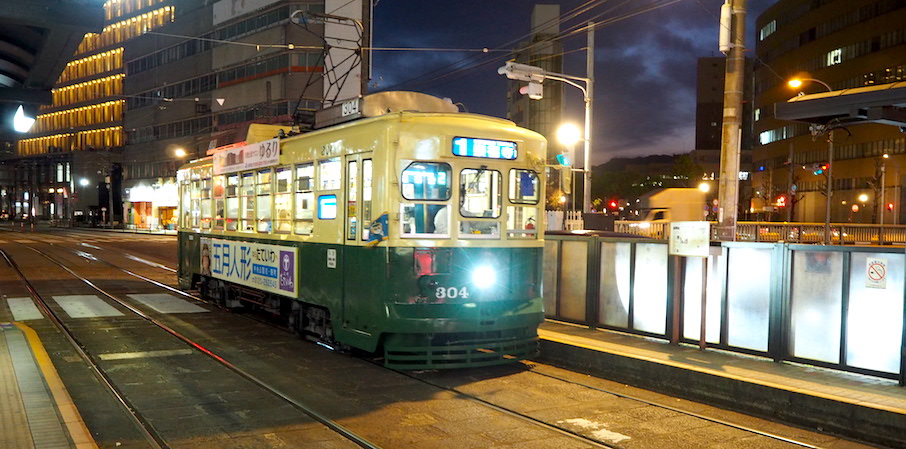
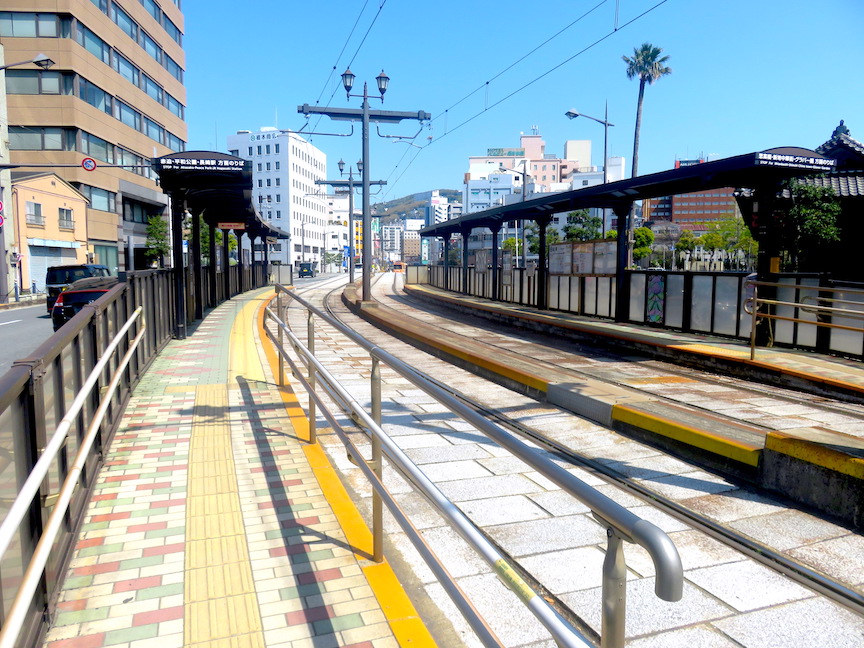
There are dozens of streetcars — also called trams — rumbling and squeaking and clanking all throughout downtown Nagasaki. And it’s definitely the best way to get around. They’re fun and very inexpensive. Regardless of distance, it’s 140 yen ($1.05) for adults, 70 yen for children. You get on. You get where you’re going. You get off. And how convenient! No descent into the cavern of a subway. Just stand at one of the many stations spaced every two or three blocks — which are everywhere — climb aboard, check in with a pre-pay electronic card like the one I have (beep!), which incidentally works on every public train, subway, bus or tram everywhere in Japan . . .

Then pay on your way out (beep!), smile at the driver, step down to the station platform. You’re on your way. To Chinatown, Glover Garden, Peace Park, the central train station, wherever.

1-Approaching-

Mind you, the streetcar system is over a century old. But it still works and apparently city planners regard it as a part of Nagasaki history they see no need to retire.

The message is this: You can leave your heart in San Francisco. No problem.

Just come to Nagasaki! They have streetcars, no homeless and nobody is packing a gun.


[ This originated at the author's personal website . . . https://jdrachel.com ]


Life In Japan: Nagasaki Streetcars | John Rachel


Sunday, January 17, 2021

Life In Japan: Tondo Matsuri | John Rachel


Tondo Matsuri festivals are held all over Japan, the second weekend of the new year, at all levels. There are major festivals with thousands of people, as well as more modest local celebrations. The central feature of the Tondo Matsuri is a bonfire, much appreciated since it tends to be cold in January, thanks mostly to the sub-zero winds that blow our way from Siberia.

This year Tondo Matsuri was held on the same day as Coming of Age, a national holiday celebrating every person turning 20, a welcome to full adulthood. Thus most people had the day off from work, making attendance convenient. Of course, the coronavirus “crisis” is cautioning people across the globe against large gatherings, sneezing on one another, licking door handles and one another’s eating utensils, and the most notorious disease spreader of them all, French kissing.


My village of Noma here in Tambasasayama wasn’t daunted by the threat of viruses. We got together, and granted, our bonfire didn’t leap 20-30 meters into the sky, as is common practice the major festival sites, but we still managed some truly heartfelt camaraderie and warmed ourselves against the winter chill in splendid fashion. Our bonfire was next to 
Benten Shrine where many similar get-togethers take place.

Once the Tondo bonfire is going, there are two key rituals.

One is burning the decorations, talismans, rakes, arrows, amulets, wreaths, blessings, and other votive goods, from the previous year, to be replaced over the new year with new ones. Many of these are items bought from local shrines and temples to bring good fortune and health. They are tossed onto the fire. After they are incinerated, each family collects some of the ashes, which are then taken back home. These ashes are called shimenawa — しめ縄 — and are considered sources of good luck and positive developments for the coming year.

Very light paper banners, with sayings and wishes written in beautiful calligraphy, are thrown onto the fire as well. They instantly burst into flames, then are caught in the updraft of the bonfire, soaring heavenward as they turn to ash. This takes the messages they contain up up up, and makes them part of the invisible energy of the universe. While this probably is more just silly superstition than a serious spiritual exercise, it reminds me of the prayer wheels of Tibetan Buddhism, which in a parallel fashion send into the divine ether the thousands of prayers the wheels contain on scrolls hand-written by the monks, usually pleas for peace and harmony in the world.


Once the Tondo bonfire is going, there are two key rituals.

One is burning the decorations, talismans, rakes, arrows, amulets, wreaths, blessings, and other votive goods, from the previous year, to be replaced over the new year with new ones. Many of these are items bought from local shrines and temples to bring good fortune and health. They are tossed onto the fire. After they are incinerated, each family collects some of the ashes, which are then taken back home. These ashes are called shimenawa — しめ縄 — and are considered sources of good luck and positive developments for the coming year.

Very light paper banners, with sayings and wishes written in beautiful calligraphy, are thrown onto the fire as well. They instantly burst into flames, then are caught in the updraft of the bonfire, soaring heavenward as they turn to ash. This takes the messages they contain up up up, and makes them part of the invisible energy of the universe. While this probably is more just silly superstition than a serious spiritual exercise, it reminds me of the prayer wheels of Tibetan Buddhism, which in a parallel fashion send into the divine ether the thousands of prayers the wheels contain on scrolls hand-written by the monks, usually pleas for peace and harmony in the world.


The second ritual is cooking mochi — 餅 — by placing it near the fire. Mochi are rice cakes and there’s absolutely no equivalent to them in the West. When grilled, they are thick and gooey with a crispy exterior, and incredibly delicious, especially with sweet red bean soup or soy sauce.


Yes, the food is very unique here, for sure.

So . . . that was our Tondo Matsuri. There were no fireworks, parades, or 21-gun salutes. The Blue Angels aerial acrobatic team didn’t fly over. No sign of a marching band or baton twirling cheerleaders.

But we still had an outstanding time!

Did I mention? . . . I love Japan!

[ This originated at the author's personal website . . . https://jdrachel.com ]


Life In Japan: Tondo Matsuri | John Rachel