Since leaving America August 2006, I have traveled to sixteen countries. A great deal has happened. This site is to share my thoughts, photos, music, writings, travel experiences, and developing political/social commentary with you. I hope you find it interesting and informative.
Until her untimely death in a freak accident at a lesbian orgy island resort in 2009, Dr. Joy Smothers revolutionized modern psychology!
Her songs, her books, her uncanny insights, her unique and powerful healing methods are as relevant today as ever.
It was the early 90s. The usual number of people were suffering from plunging self-esteem. For the past decade, the book shelves had been bursting at their pressboard seams with every conceivable fix.
Psychiatrists were booked up for months. Gurus were turning them away at the door. Lifestyle coaches were rolling in dough from workshops, book sales, self-help tapes, videos, tête-à-têtes, seminars.
High priests, low priests, monks, ministers, astrologers, palmists, psalmists, phrenologists, hypnotists, aura readers, astral pocket jockeys, harmonic wave surfers, all were the rock stars of a new age of enlightenment.
But the zaniest of all of the obvious signs that the world had gone completely mad and people would embrace just about anything or anyone in a desperate attempt to conjure up the NEW YOU, was the lady we will meet in this book. Unorthodox? How about Alice in Wonderland strange. Weird. Off the charts. Barking mad. Totally whack. We’re talking about … Dr. Joy Smothers, the folk singing psychologist.
The thing is, you can’t argue with success. And tens of thousands of people whose lives were in shambles, whose ability to understand the world around them and relate in a holistic, positive way to others, swear by this lady. They believe in her gifts for healing, embrace her unorthodox teachings and methods, and unquestioningly ascribe to her almost supernatural powers.
So . . .
This is her story.
This is how it all began!
You decide . . . was Dr. Joy a genius or con artist?
[ Author’s Note: Granted, this is a slight change of tone from my previous posting. The point is, the literary merits of my book are not relevant to discussing the emergence of one of the most controversial individuals in the history of psychology — a woman no less, in a field as patriarchic as the National Basketball League. It’s only fair that you judge for yourself both Dr. Joy Mania and her putative impact on individual and family therapy. Of course, this begins with your buying at minimum ten copies of Sex, Lies & Coffee Beans and sharing them with family, friends, even passing strangers. Then think about it, talk about it, write about it, make this the core purpose of your life for the next six to eleven months. I personally can’t see any other possible course of action.
I’ve put the finishing touches on the worst book ever written.
Scheduled publication date is December 18, 2020 — a day that will go down in infamy.
This book will offend everyone.
The woke crowd will find it so politically incorrect, they’ll only stop gagging long enough to upchuck screechy memes about gender bias, misogyny, and homophobia.
Normal folks will find it beyond rude and insulting. They’ll see themselves in the story. It’s not a flattering picture.
Critics will resist even pretending to look at it. The plot is one long flat-line, the characters one-dimensional, the premise facile and implausible, the message superficial and without any redeeming qualities.
I’ve warned my friends and relatives to stay as far away from this piece of literary garbage as possible. If curiosity gets the better of them, I accept no blame and take no responsibility. They were warned.
Why would I write something like this?
That’s easy. In the world of digital publishing, in this age of internet mania, click bait, and mindgame porn, the #1 priority is to separate yourself from the crowd, stand out, get people talking. As an author, there are only two ways to do this. Either write the best book in the world or the worst. I took the easy route.
I’ve achieved what no other author has achieved, or even tried to achieve. This book is so bad, it’s in a class by itself.
It’s a sure #1 at Amazon in …
Literature / Contemporary Fiction / Psychological Dystopia / Euthanasia / Brain Freeze / No Refunds
I’m asking each and every one of you out there to immediately buy this book. I don’t know most of you personally but I want your money. And you don’t know where I live. Don’t come looking for a refund.
Come on! Get on the bandwagon. Sex, Lies & Coffee Beans will give you something to talk about with every one else standing in the checkout lines at Walmart or waiting to get tested for Covid-19.
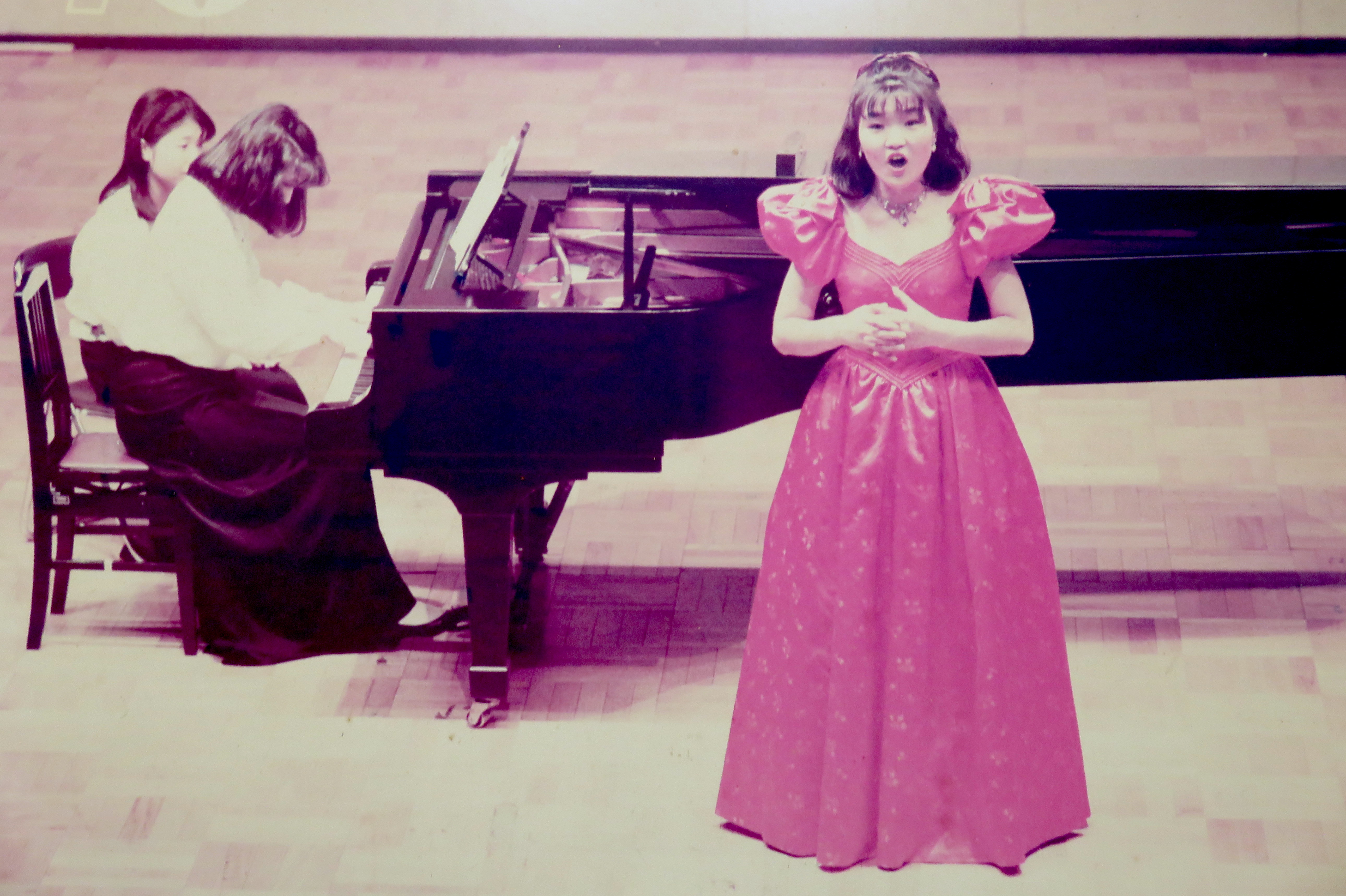
This is a photograph of my wife, Masumi, at age 20 singing Il Bacio by Italian composer Luigi Arditi. She has been singing opera all her life, plays beautiful classical piano, and dances ballet as a pastime.
I find it a fascinating question why Japan is so enamored with Western art forms, not that I've made any progress coming close to a conclusive answer.
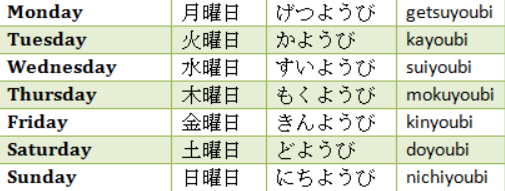
Of course, Japan has always been an eclectic culture. It has adopted much from the West, including English letters and words, integrated via Romanji, one of their alphabets. Entire English words were Japanized and have become a part of the ever-evolving vocabulary, e.g. resutoran レストラン (restaurant), aisukurimu アイスクリーム (ice cream). Going way back, certainly quite a bit has been "borrowed" from the Chinese, most notably, Kanji, another of the alphabets in everyday use. And in the 19th Century, Japan replaced its cumbersome numbering system with Western Arabic integers.
All of this is the normal cross-pollination of cultures, which occurs when borders become more permeable, trade encouraged and opportunities for tourism pervasive.
Yet, there are some things that either don't translate well, resist integration, because they are simply entirely incompatible with established social traditions and cultural legacies.
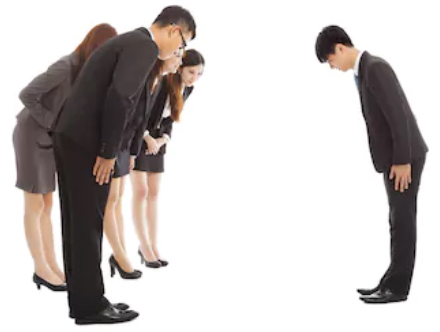
Westerners are touchy-feely, given to open, sometimes histrionic expressions of emotion. Japan is entirely the opposite. I suspect it will always remain so. A respect for privacy in both directions, each individual's large inviolable personal space, shyness and reserve, all are too thoroughly entrenched in the Japanese psyche. Yes, they may dress like Westerners here, but you're not going to see chest-bumping or hugs and kisses at the mall, or simulated sex on the dance floor. It's just not going to happen. Bowing is about as wildly intimate as it gets in public.
That, of course, is an example of steadfast social training.
But I would have suspected that another type of training would be just as determinant. I'm referring to ear training.
The Japanese scales -- actually all Asian scales -- are microtonal. When they don't sound randomly annoying, they sound intentionally grating, at least to my Western ears. I'm just not used to hearing -- literally not trained to hear -- the two or three notes that purposely occur between C and C# or between E and F. I'll admit that in my band days I was often accused of tuning my guitar microtonally but that was just a way of saying I had a really lousy sense of pitch.
Regardless of how much their melodies may torment us Westerners, Asians will swear by the beauty of the music they create and listen to. Their ears are trained to hear, accept, embrace what sounds cosmically wrong to us.
At the same time, Western music and the fundaments for making it have gripped Japan. And in every form: pop, rock, jazz, classical, blues, rap, hip hop.
Recognize that there are Western arts chauvinists who would say this is inevitable. They will make a very convincing argument that Western scales are fundamentally superior, more accessible and natural to the homo sapiens physiological mechanisms involved in processing music.
There is a very appealing mathematics to the Western scale. The 37th key on an 88-key piano is A. It vibrates at 220 cycles per second (Hz). The 49th key is also an A, but it's one octave above, vibrating at 440 Hz. The 25th key is an A that's one octave below, vibrating at 110 Hz. Nifty, eh? This suggests the mathematical foundation underlying the tonal relationships among the notes of the Western 12-tone scale. In fact, this holds together quite nicely until we get to the very bottom and top of the useful musical range. The math has to be adjusted a bit. Pianos tuned to mathematical perfection tend to sound sharp at the very top and bottom, requiring at the extremes that the scale be "stretched" to make the piano sound in tune to the human ear. This is not a flaw in the mathematics. It's a consequence of the physical properties of the strings of the piano, a stiffness which causes inharmonicity at the extremes. Thus this need to "temper" the scale doesn't diminish the essential elegance of the theory.
Zeebra, a very popular hip hop artist here in Japan
(Click on pic to see a video.)
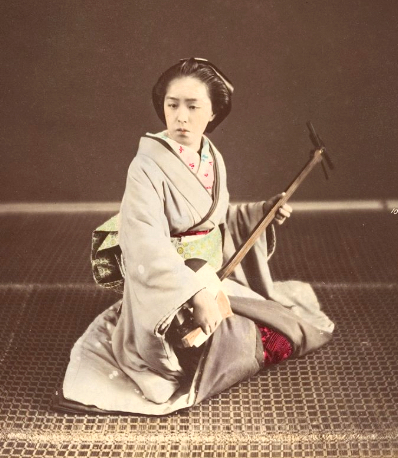
So as I say, it's easy for music experts in the West, the ones juxtaposing Fibonacci spiral graphs on the human cochlea, to posit the intrinsic superiority of a viola over a shamisen, an oboe over a hichiriki, or a flugel horn over a horagai, put in the service of playing the Sound of Music.
They may be right. But the bottom line is there's really no way to objectively settle the matter. An anecdotal aside: I mentioned to my wife the other day that one of my English students sings Japanese folk songs to me. The lady is very proud of her voice and the songs she had spent her life mastering. My wife asked me if they were traditional or modern folk songs. I didn't know there was a difference. Turns out that traditional folk songs are the original microtonal versions. Now there are modern versions of those folk songs which make the melodies fit the Western 12-note scale. Think about that! They take these amazing songs from time immemorial and update them -- literally Westernize them musically -- for the prevailing tastes of contemporary Japanese listeners.
This seems to suggest some greater inherent appeal in the mathematically-based music system of the West. But I say it's just a sign of the times. We have Burger King in Beijing, KFC in Kuala Lumpur, McDonald's in Moscow. There are rappers and hip hop artists in every country that has electricity, except maybe Bhutan.
My wife, Masumi, of course continues to teach Westernized music to elementary students in a nearby community here in Japan, as part of the official school curriculum. The kids play recorders, xylophones, accordions, keyboards, snares, bass drums, bongos, congas, and other percussion -- all instruments from the West. And since she still loves singing, she even gives an occasional vocal performance under the auspices of the vocal teacher she's studied with for three decades. Usually she sings opera, though she occasionally helps me out on my original songs, in my informal home recording studio.
Here she is earlier this year in concert at a gathering in Osaka.
[ This originated at the author's personal website . . . http://jdrachel.com ]
This is not going to be a formal or particularly thorough discussion of Western art forms here in Japan. In fact, it'll be largely anecdotal but nevertheless I believe an accurate portrayal of the odd juxtaposition of the unambiguously Western art forms and styles on a culture with its own unique rich heritage, which not in the least resembles or had been influenced by Euro-America until Japan finally was "opened" to the West 165 years ago. Significant Westernization occurred in two peak periods: From 1868-1900 during the Meiji restoration, and from 1945 until the present following the Allied victory over Japan ending World War II. This resulted in modern Japan, where Kibuki Theater and geishas co-exist with American-style pro wrestling and Japanese hip-hop.
My wife, Masumi, perfectly embodies the contradiction, though unlike most contradictions there are no discernible incompatibilities or anomalies. 'Contradiction' is really the wrong term. Because all that is contradicted are my expectations. I'll get to Masumi in Part 2, as she deserves an entire article of her own.
Long before I ever knew I'd be coming to and then settling in Japan, I received some early inklings about Japan's love affair with the West, meaning not just its superficial courtship of dress and hair styling, but its thorough embrace of both formal and pop arts.
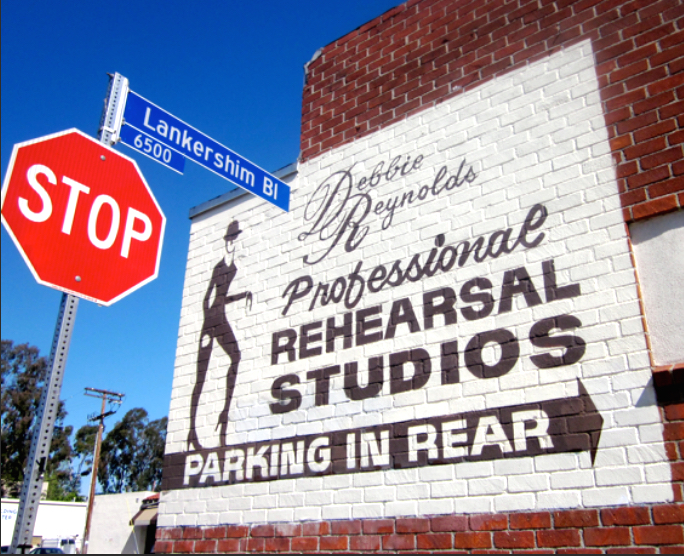
I was taking jazz dance classes at Debbie Reynolds Studios -- yes, that Debbie Reynolds -- in Los Angeles, and one summer a plane load of young Japanese jazz dancers (late teens, early twenties) packed the classes. To put it mildly, I was amazed, stunned, awed! Not only were they physically perfect as dancers -- slender; strong, sinewy muscles; elegant posture; each individually radiating grace and vigor, coupled with a charming shyness -- they could really dance!
I also wistfully recall one of my favorite dance teachers mentioning that he loved taking on guest teaching positions in Japan, because the students were so fiercely dedicated and disciplined. When he'd return from such an assignment, he'd jokingly count off our dance routines in Japanese: ichi, ni, san, yon! While we thought that was pretty darn cute, I never gave it all that much thought. Japan just wasn't on my radar screen back then.
At the same time, it was no secret that Western performers, in particular pop and rock acts -- everyone from the Beatles, Cindi Lauper, Santana, Carpenters, Michael Jackson, ABBA, Rolling Stones, and Avril Lavigne, to Ozzy Osborne and Bob Dylan -- loved playing Japan. All reported that Japanese audiences were enthusiastic and they felt truly appreciated.
Get this: Even jazz artists like Chick Corea, Art Blakey, Oscar Peterson, Sonny Clark, Miles Davis, Billie Holiday, Bill Evans, and John Coltrane had and often still have impressive fan bases in Japan.
Much more popular and widespread than jazz is classical music. During my first full year in Japan, I was invited to attend a piano recital. I don't know what that sounds like to you but I assumed it would be a bunch of cute kids fumbling their way through simple songs, their adoring parents taking videos for the grandparents. Right. Try concert-level Chopin, Mozart, Brahms, Beethoven. And these were just high school students! Turns out that studying piano from a very young age is pervasive here -- piano lessons with a focus on eventually mastering the legends, for example, those just mentioned. Japan has, of course, already produced a number of widely-acclaimed, world-class musicians and composers, and believe it or not, Tokyo alone hosts "no fewer than eight full-size, full-time, fully professional orchestras, collectively providing more than 1,200 concerts a year."
Getting back to dance . . .
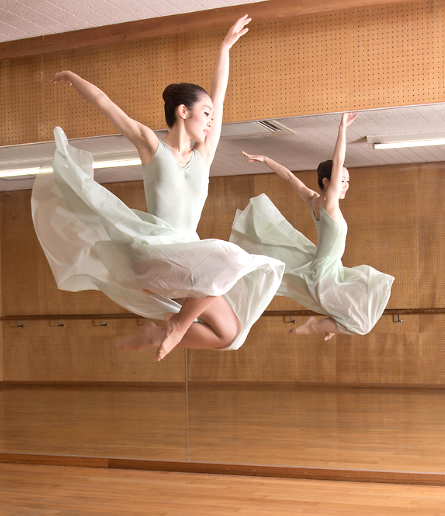
I've been a longstanding fan. I saw my first ballet in high school. Not only did I take some jazz classes for ten years starting in 1985, I even dabbled in both modern and ballet over the years. The great ballet dancers like Baryshnikov, Nureyev, Fonteyn, Markova, have always fascinated me.
That being the case, about a year ago I became acquainted with a fellow who is not well known in the West, but in my opinion may be one of the best ballet dancers ever! His name is Kumakawa Tetsuya. Born in Hokkaido, Japan, he studied in England and became a principal dancer with the Royal Ballet, before returning to Japan to form his own ballet company. Feast your eyes on a man who seems able to rewrite the laws of gravity . . .
. . . and make challenging moves breathtakingly beautiful and inhumanly effortless . . .
There are two Japanese ballerinas, who despite being in my opinion, among the best in the world, are not exactly741 household names in the West.
Kuranaga Misa . . .
. . . and Nakamura Shoko . . .
Pretty amazing, eh?
If there is an unspoken, but nonetheless dutifully-regarded and rigorously-observed rule in play governing just about every act, action, activity, ambition, and endeavor here, it's this: Whatever the Japanese do, they do well. They are maddening perfectionists. Many would say this is why Japan was able to rebuild so quickly and totally after World War II, eventually becoming the world's third largest economy. Others would attribute Japan's high suicide rate to the extreme pressures of high performance and achievement.
Both would be right.
[ This originated at the author's personal website . . . http://jdrachel.com ]
Yes,
I'm still climbing the mountain near my house here in Japan. Only twice
a week now. It has been COLD! Maybe not by Michigan standards (where I
grew up), but I've lost all of my tolerance for low temperatures. I
think living in Southern California for fifteen years recalibrated my
body's thermostat.
So
to make my twice-weekly pilgrimage up the mountain, I bundle up like
I'm exploring the Siberian tundra. It's well worth it. The calm, the
quiet, the meditation, the centering has become a ritual I can't live
without. Well, I guess I would live. But I'd be more insane than I
already am. My wife, Masumi, has yoga and ballet. I stumble up and
down a big mound of dirt. Works for me.
Today
my trek was a real adventure and a phenomenal treat. While normally we
don't get that much snow here in Sasayama -- and when we do, it
typically doesn't linger more than a day -- this weekend we got over 12
cm (5 inches) and it stuck around.
Now
I don't own proper hiking boots. And given the variations in
temperature, sometimes I was plowing through snow, other times
negotiating slush and ice. My feet ended up very numb and at times I
felt like I was roller skating on Teflon. I'm proud of myself. I only
fell once -- no broken bones. And my piggies thawed out real nice. None
had to be amputated. I didn't even get chillblain itchies! Anyone
growing up in severe winter weather will know what I'm talking about.
Anyway, here are a few photos.
I know how good I have it. I thank the karmic lottery every day for the life I fell into.
Is it so unreasonable to think that every single person in the world deserves this?
Just a simple, basic shot at happiness, free from hunger, fear, war, oppression.
Not
that I expect it to shine any light on my random musings, here's a song
by Paul Simon. (Is he still married to Edie Brickell? Last I heard,
their neighbors were complaining about the noise from them screaming at
each other during their epic connubial squabbles.)
I don't feel so all alone.
I guess everyone's still crazy after all these years.
[ This originated at the author's personal website . . . http://jdrachel.com ]