Since leaving America August 2006, I have traveled to sixteen countries. A great deal has happened. This site is to share my thoughts, photos, music, writings, travel experiences, and developing political/social commentary with you. I hope you find it interesting and informative.
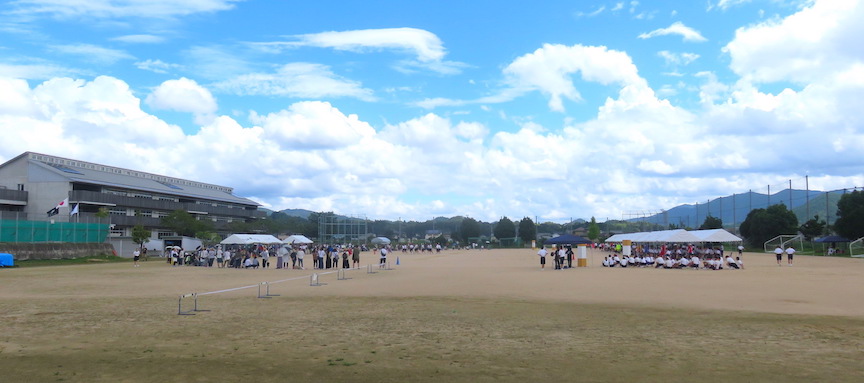
Above is the annual sports festival at a local junior high school here in Sasayama. These much-anticipated events take place at every school in the country around the middle of September — even pre-school and kindergarten!
To say they’re popular is an understatement. They are as much part of the fabric of social life here as eating rice and fish.
The events at a Japanese sports festival include some “normal” sports contests, e.g. relay races, tug-of-war, team rope jumping. But they as well have quite an assortment of unique, and I have to say, quite amusing activities I wouldn’t expect to show up in the Olympics anytime soon. There’s the hacky sack basket toss, the three-legged kick-the-ball then shoot-a-hoop match, a relay race carrying a tennis ball on a tennis racket while running at full-speed around the circumference of the field.
Sports festivals are not restricted to just students. Villages compete against one another, meaning full-grown adults also participate in the action. I can’t say the village I live in does very well in these competitions. We may have the most geriatric team in all of Japan. But we have a great time, which is mainly what these all-ages competitive events are all about.
Here’s a mercifully short video of my legendary performance at a recent community sports festival. If it’s not entirely obvious, my challenge — for which I trained with the best coaches east of Nagasaki — was to inflate a balloon, pop it by sitting on it, then scramble back to the starting line, tagging my next teammate in line, who we hoped would repeat my gold medal-level performance, and lock in first place for this epic showdown.
What can I say? It seems no matter what the season is, there’s always something going on here, and whatever it is is typically is built around some excuse for people to get together, have a good time, and simply enjoy the company of those living in the community.
The sub-title of my newest book begins “Anecdotes on the People and Culture of Contemporary Japan …”
Here are a few anecdotes which will give you phenomenal insights into the remarkably high ethical standards and general character of the Japanese people.
• • •
A friend of mine, originally from New Zealand but who lives in Japan, left her latest model Macbook Pro in a train station ladies room. For two hours! She had left it on the counter while she washed her hands and forgetfully walked out without it. By the way, this was one of the busiest hubs in Japan, the Umeda JR Station in Osaka. That restroom has hundreds of people going through it every hour. She got quite a ways along on her trip back here to Sasayama, remembered, jumped off, and immediately got on a train back to Osaka. She found her laptop right where she left it. Yes … two hours later!
• • •
Every year in October, we have here in Sasayama the Festival of the Portable Shrines. It’s one of my favorites!
A gentleman arrived here from Kobe, which is about an hour away. He came to purchase black beans, an item my home town is famous for, but when the moment came to pay, he discovered his wallet was missing.
There are no pickpockets around here, so obviously he had dropped his wallet somewhere in town.
He went to the nearest Koban. There are several here in Sasayama, as there are all over Japan. A Koban is a mini-police station. In Japan, it’s considered an integral part of a functioning community. The Koban is to make sure there are friendly cops in the neighborhood to address problems which come up in the local area, situations just like this.
The policeman on duty took a report, then got on the phone. He called all the other Kobans in the immediate area, anywhere close to where the gentleman had parked his car, before walking into the main part of town for the festivities.
He passed along the man’s name and a description of the wallet. Now get this …
While the officer was on the phone with another Koban, someone walked in with the wallet and handed it to the policeman on duty there.
The gentleman from Kobe then walked the short distance to the other Koban, and retrieved his wallet. The contents — credit cards, ID, cash — were intact. Not a single item had been taken.
• • •
One Sunday many months ago, we went to, Rurikei, our favorite local onsen. This is one of the great joys of living here in Japan and we try to go often (see next section).
Anyway, I left my hair brush in the mens locker room. This was not a family heirloom. This was an 89 cent piece of plastic, dirty and full of my hair from use over many months. The only thing it had going for it was that it was a pleasant shade of lavender.
Five weeks later, we returned to the hot springs. On some impulse — my synapses tend to fire randomly at times — I asked at the counter if they had a purple hair brush in their lost-and-found box. Stupid me. I was thinking they had a cardboard box behind the desk. The clerk asked when I thought I had lost it. That was easy. Maybe four or five weeks ago? He stepped into the facility’s main office, consulted with someone, then returned with my 89-cent hair brush, safely contained in a sealed plastic bag with a label. On the label was the date I left it in the locker room.
• • •
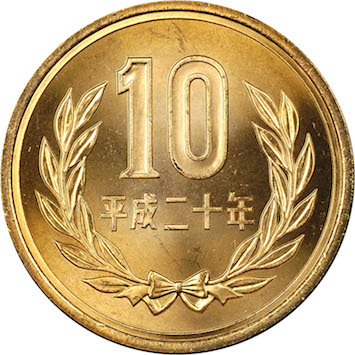
Masumi reminded me of this story, one I had forgotten. One day we went to Japan Post to mail a package to the U.S. — I think it was one of my novels, sent off for a review. Shortly after we returned, the phone rang. It was the clerk who had waited on me at the post office. She first apologized. She had made a mistake and overcharged me. She was so sorry this happened! It was an honest mistake and would be happy to refund the money. How much was it? 10 yen. Unbelievable! Do you know how much 10 yen is at current exchange rates? 9.44 cents!
What did I do? I did what any red-blooded American would do in the face of such incompetence! I went to the post office with my AR-15 and shot the place up. I didn’t kill anyone, though obviously I could hardly be blamed if I had. But when I got done, the place looked like one of the Twin Towers on September 12!
Okay. Obviously, I made that up. The truth was, I was speechless. 10 yen? After I stopped laughing — pleasant, joyful laughing — I had Masumi tell the clerk all was forgiven and she could keep the 10 yen. I think you can probably buy a lollipop somewhere for 10 yen.
• • •
I could go on and on. For example, in the news several months ago, there was the story of a person who had found a satchel on a park bench with over 5 million yen (that’s $50,000 cash) and no identification of any kind in or on the bag. It was promptly turned into the police.
I’m not going to moralize. Draw your own conclusions.
But by seeing such extreme honesty here, I see what has happened to my own country. I’m not pointing fingers. I see it in my own thinking. It’s been quite an adjustment for me. After all, I grew up in a tug-of-war between what I was taught at home, school and church, and real world a prioris: ‘Finders keepers losers weepers.’ ‘It’s every man for himself.’ ‘If I don’t take it someone else will.’
As a kid, often it wasn’t a question of right or wrong, but a question of whether we’d get caught.
I will say that dishonesty, regardless of how minor or seemingly insignificant, is a slippery slope. The Japanese have chosen to avoid taking even the first step.
I openly admit, it’s resulted in a huge paradigm shift for me. It’s required an enormous adjustment. But an extremely rewarding one. Just imagine … being able to trust other people. What a concept!
Understand: This extreme level of honesty and respect for the property of others I’m describing here is not an anomaly. It’s the norm. And it’s nothing new.
My American friend, Scott Burley, recently emailed me about his brief but rewarding experiences visiting Japan. He included this story:
My girlfriend who I met sophomore year … went on a student exchange program to Tokyo for her junior year and went to school over there. She was 1/2 Japanese and 1/2 Czech and her parents were both Japanese — her mother must have married a Czech before her step father. So around Christmas I flew to Tokyo when she had Christmas break and we spent three weeks traveling by train … my girlfriend left her purse at a bus stop. I went back to look for it and it was gone. After we got back to Tokyo, one day her purse arrived in the mail. Only in Japan!
That was back in 1973. Some things don’t change here.
It’s quite a story how Sophie came into our lives.
Masumi was going to her drum lesson at the other end of town. This was at the Yamaha music education space, which happened to be across the street from a factory.
As she got out of the car, a skinny calico came running from the factory yard right up to her. The poor thing was undernourished, had runny eyes, in general looked sick and sickly. But she had lots of energy and came right up to Masumi, reached up on Masumi’s legs and cried for help. Normally, street cats are very skittish and unapproachable. This little kitty was completely the opposite. She wanted attention and affection.
Masumi’s drum lesson lasted over an hour. When she came back out, the calico was still there, waiting for her “chosen” friend. She continued to cry and rub up against Masumi, and when she opened the car door, the kitty jumped in the car!
Next I got a call. “What should I do? This poor little kitty jumped in my car. She wants me to take her home.”
We decided that whatever was to happen, we should try to help this poor creature out. She was in trouble, it was winter, no way would she survive in her condition outdoors in the yard of a factory. What was she living on? Was she getting fed?
Masumi drove with the calico in a cardboard box directly to our vet. Poor little thing was starving, had worms, and a bad cold. How could we turn her away? Masumi came home and it was no decision. If we could manage it, this new kitty would join our family.
The immediate serious issue was whether our new friend had either kitty HIV or leukemia, both of which are fatal within a couple years of infection. Both are also very contagious and are common among “street cats”. We had concern about Arthur and Jennifer catching one of these dread diseases. At the vet, at least for now, the calico tested negative for both but we’d have to wait four weeks and have her retested, in case she had just recently gotten infected. Four weeks isolated from our other two cats!
We set up a room. I spent about half my time keeping her company for the next month and grew incredibly attached. She was hysterically funny, so full of affection and appreciation. Our other cats, Arthur and Jennifer, spent countless hours at the door of the quarantine room wondering just who this mystery guest was. They heard her frolicking, jumping around the room, using me as a cat tower, slowly gaining strength, health and energy.
We decided on a name . . . Sophie!
Four weeks crawled by. It was time for a “final verdict” from our veterinarian.
I have to say that after all that time in quarantine with her, it would have broken my heart if her tests had come back positive. But she was clean! As soon as Masumi returned from the vet, she brought Sophie into the house, opened the carrier. Arthur and Jennifer got to meet the newest member of the family.
The three of them are to this day the best of friends, regularly play together, are very affectionate to one another. The perfect ending! Sophie is truly the most delightful kitty I’ve ever had. She cuddles up to me several times a day while I’m writing, brings both Masumi and I toys she wants us to play with, sleeps with us every night.
So . . .
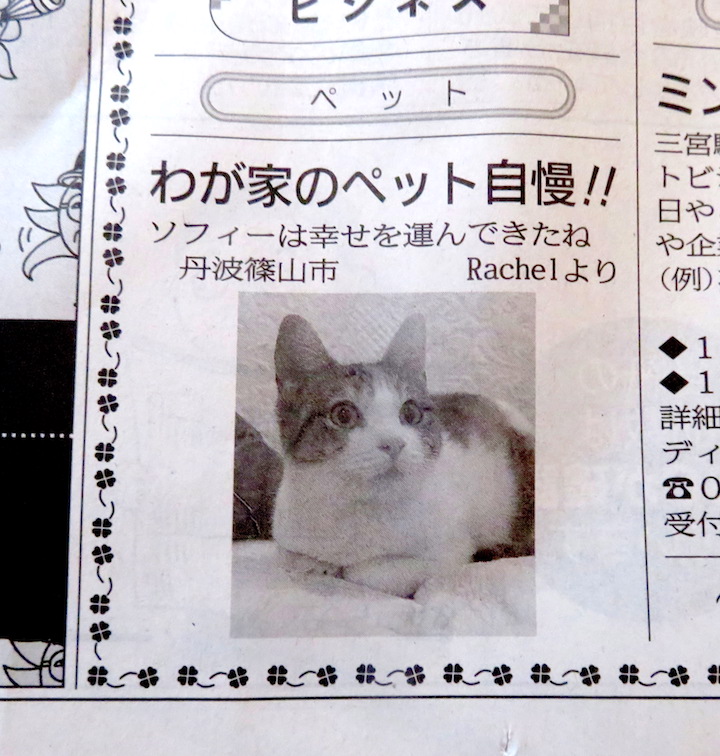
Finally, in a long-overdue recognition of Sophie’s long, dramatic journey in becoming a member of our family, our local newspaper has published the brief notice you see above. It merely says she has brought much joy to our household. Talk about an understatement.
Sophie is definitely one-of-a-kind, an “orphan” and a real Cinderella story!
As an attention-starved author and overgrown baby, I of course am always trying to attract publicity. Again, one of my kitties has humbled yours truly by being featured in our local newspaper.
Maybe I'm approaching this wrong. Do I need to learn how to purr to get noticed around here?
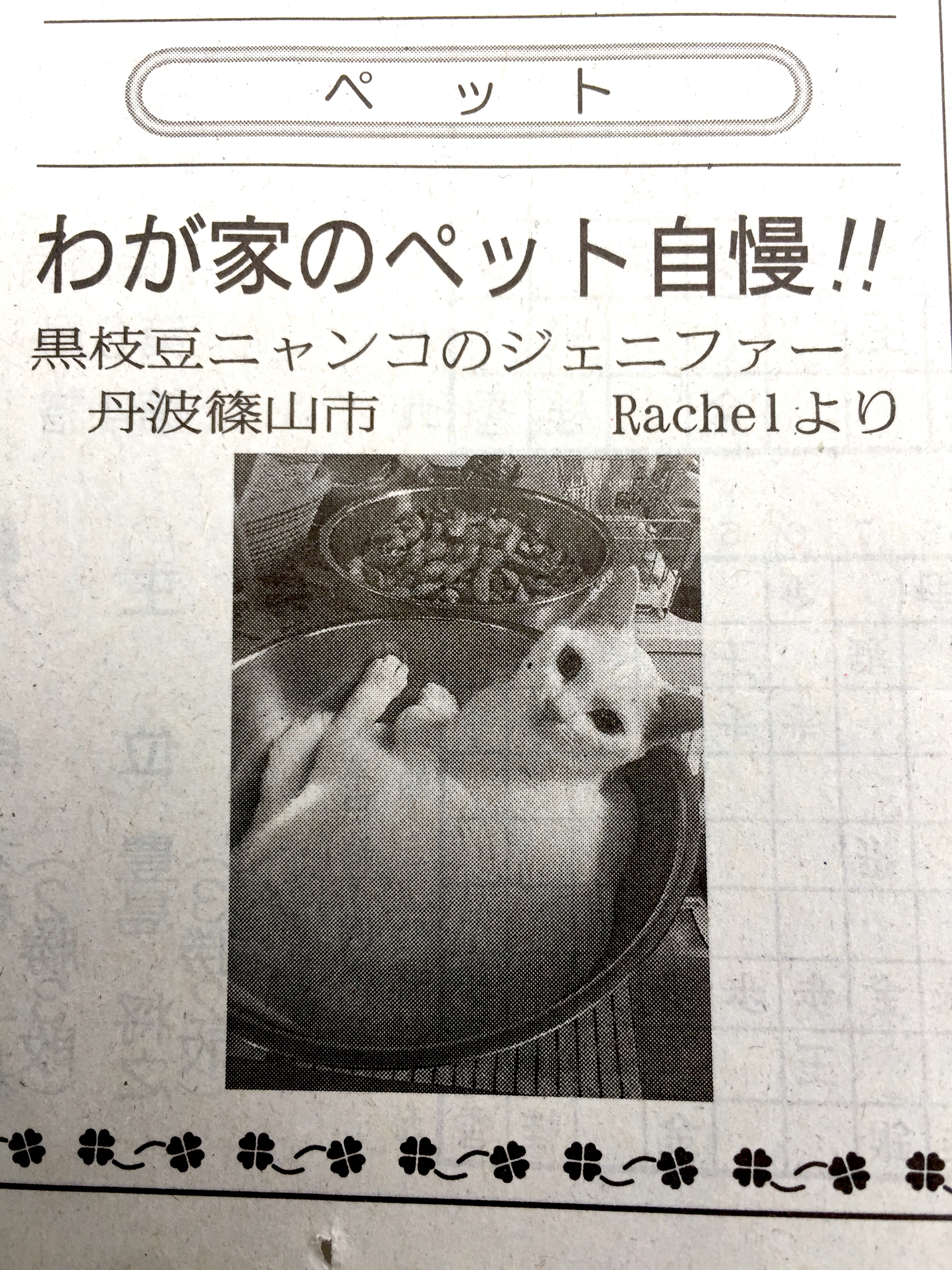
Of course, the selection of local pets for cameos is not random. And since our kitties are the most beautiful in the world, what choice is there but to run their photos and say a few complimentary, if inadequate words? I'm frankly surprised they don't write them up on the front page with a huge eye-catching headline like . . .
JENNIFER THE CAT STEALS EVERYONE'S HEART IN SASAYAMA
. . . or create a special standalone section for them like the Arts & Culture Magazine of the New York Times.
You think I'm biased? Check out these photos!
Which gets to the heart of the challenge for me personally. At least in the cuteness department, I simply can't compete. So I need to create my own separate niche.
I got it! I'll write novels! Incredibly cute novels. With cute covers. And cute characters. Cute story lines. Cute plot twists.
Novels that purr!
Hmm . . . I may have gotten off to a bad start. Politics? Satire? Human trafficking? Growing up in Detroit? The end of the world? Drug smuggling? Eating giraffes?
I taught English full-time here in Japan for a whole year in 2008. There were all levels of classes, all ages, from beginner to advanced, from 4-year-olds to folks in their eighties.
One Friday morning in August or September, I walked into my advanced English class, situated at a cross-cultural community center on the edge of town, and it was obvious something was being shared my students thought was funny which I apparently wasn't supposed to know. They were giggling and looking conspicuously guilty. It was a small class, only five students, and I guess I caught them somewhat by surprise. Which itself didn't make sense, since it was one-minute before class was supposed to start. Perhaps they wanted to be caught in their conspiratorial pow wow.
"Okay, students. What were you talking about? What's so funny?"
"Nothing, JD. We were laughing about something?" As they continued to giggle.
"We have no secrets here. You're required to tell me what your conversation was all about. I think it might be a law." (Conferring among themselves.) "Should we tell him?" "Really?" "I'm embarrassed. You tell him." "No, you tell him."
Finally, one of them spoke up.
"Uh . . . it's just . . . actually . . . you have a nickname here in Sasayama."
"A nickname. I have a nickname? What nickname?"
"Yes. People here call you [more giggles] . . . the naked American."
"The naked American? The naked American! I don't understand. Why would they call me the naked American?"
"Well . . . people see you riding around on your bike without a shirt."
Without a shirt.
I thought about it. I'd never really noticed. Did I ever see any guys without their shirts? It's not something I really pay much attention to.
Of course, in the U.S. it's very common in hot weather for us fellows to whip off our shirts to stay cool. There are even signs in convenience stores: No Shirts, No Shoes, No Service!
I started to look around. I've been paying attention to this important item now for about eleven years. And quite honestly, I have only seen a man without a shirt once or twice. In eleven years!
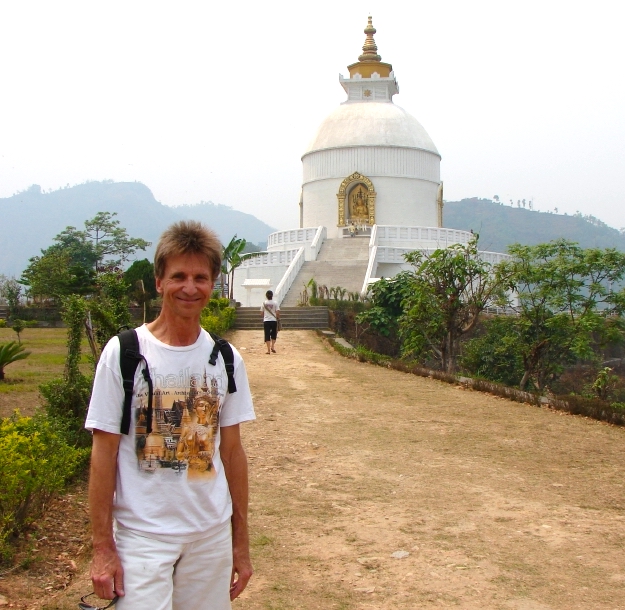
This reminds me of my three months in Nepal, a rustic, conservative country. For six weeks I lived in a beautiful town called Pokhara, enjoying its natural beauty, lovely lake, Peace Stupa, friendly locals, great hiking, calm.
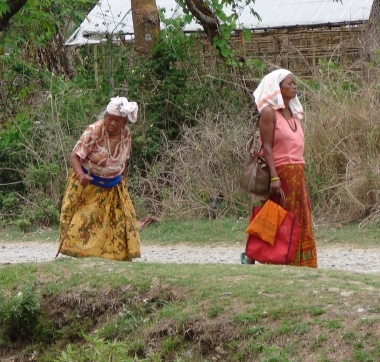
I specifically remember thinking how insensitive many Western girls were. All of the local women dressed very modestly, as Hindus and Muslims, covering themselves head to toe in beautiful genuis, informal sari-like gowns.
It was very obvious what the local standards of modesty were. Agree with them or not, this was their culture and I thought it appropriate to be respectful. Yet, because the weather in Pokhara was hot to very hot, the ladies from Australia, Europe, and so on, walked around in halters and bikini tops with their bellies bared, side boobs and cleavage in full display. Then there were the shorts, short shorts, very short shorts. The overall effect was more exposed flesh than covered.
How inconsiderate!
How insensitive!
How rude!
Uh . . . sort of like me riding around on my bicycle without a shirt here in Japan.
Busted . . . and humbled!
At the same time, I now understand things are changing in the U.S. in some unanticipated ways. Not that I have any intention of going back to witness the new "freedoms" in person, I just read that women can go topless now in six states in the U.S., as decided in a recent federal court ruling. "It’s a huge victory for plaintiffs Brit Hoagland and Samantha Six, who sued the city [Fort Collins, CO] over its law as part of the #FreeTheNipple movement, calling it an attack on gender inequality."
See? I was WAY AHEAD of my time, the creator of a new social movement, and I didn't even realize it -- the #FreeTheNipple movement!
I'm so heartened that people are putting time and energy into the real threats to happiness and health here on this planet.
熊野新宮神社, Kumanoshingu Shrine, is not too far from our house. It's famous around here for its spectacular Japanese Maple trees, which in November turn fire red, yellow, orange, brown, and every shade in between.
We make a point of going there every year, as do many other people.
Temples and shrines are everywhere here. They come in all shapes and sizes, from huge sprawling complexes which take up several hectares, to single buildings sitting on a tiny patch of dedicated land. There are the obvious ones which are located on main streets but I personally love the ones that are tucked off in a copse of trees, that are at the end of a trail up a mountain, or just sitting somewhere in isolation.
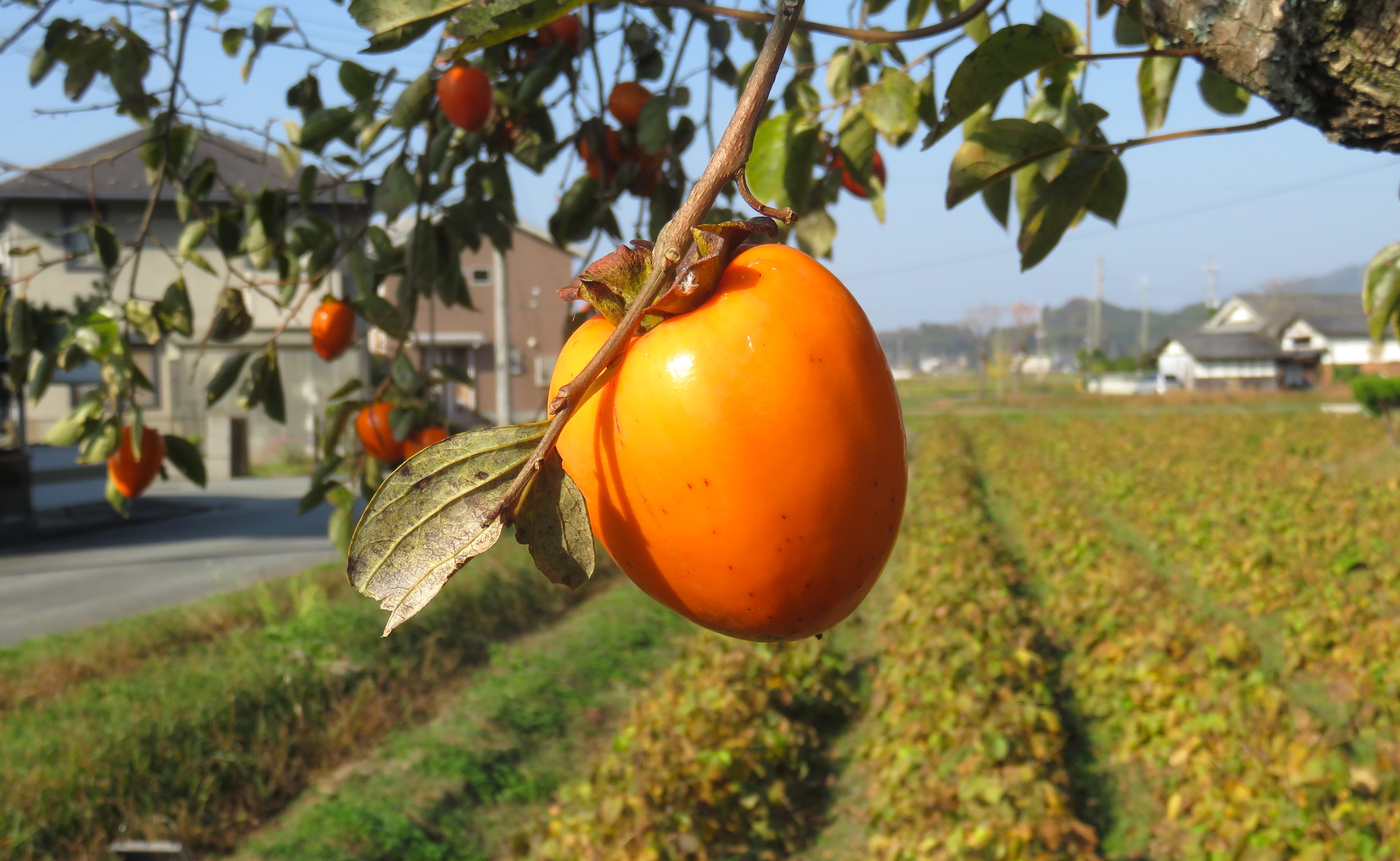
I confess. I never saw, much less tasted, a persimmon until I came to Japan. I must have heard the term before. Maybe I read it in Walden Pond or some Emily Dickinson poem. Persimmon trees definitely didn't grow where I lived in Michigan during my formative years. Actually nothing much grew at all in Detroit other than racial tensions and poverty.
You have to be here the right time to see persimmons. Meaning, my first time in Japan, consisting of a month in July 2007, I certainly didn't spot any. The fruits come out in all of their orange majesty late October. So it must have been 2008, when I was here for the entire year.
I find it very difficult to describe the flavor of a persimmon. It's completely unique. Of course, as a fruit it tastes like a fruit, as opposed to pork ribs or licorice. But even as a fruit, it's different, delicious in its own special way, with a waxy skin and a crunchiness to the meat more like an apple than a banana. Until they are very ripe, at that point turning to slime, they aren't very sweet, which is probably why Japanese people like them so much.
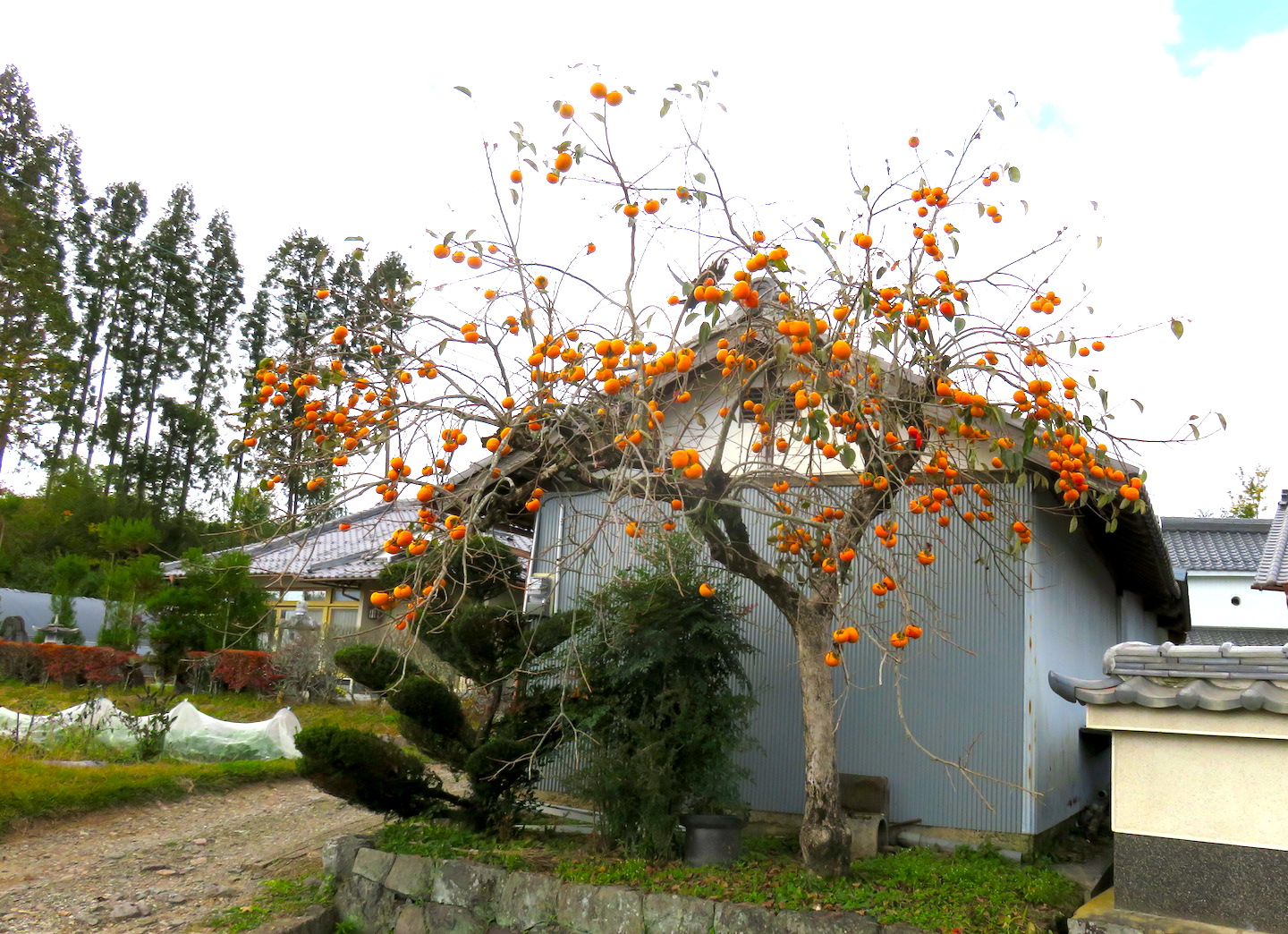
What I truly love about persimmons is the way they decorate the landscape. Every tree becomes sort of a Christmas tree but with only orange bulbs, and obviously no flashing lights, tinsel, or star on top.
Hmm . . . usually I talk politics, philosophy, metaphysics. And here I'm carrying on about a fruit. Does that make me sound like a fruitcake?
I like it here in Japan. I pay attention to different things. Most of the people around me are farmers. They know things I didn't even know I didn't know. All this is still quite new to me. How many people at my age can say honestly that life is still full of surprises and wonder?
Three times a day, I hear the ringing of temple bells at a local Shinto shrine. How do you set your watch? I don't even own one. When I hear about some horrible incident going on in this chaotic, increasingly hostile world, I can honestly say: That'll never happen on my watch. The worst thing that could happen to me at this point is, late in October, I might get hit on the head by a falling persimmon, as I ride my bicycle to town to buy groceries.
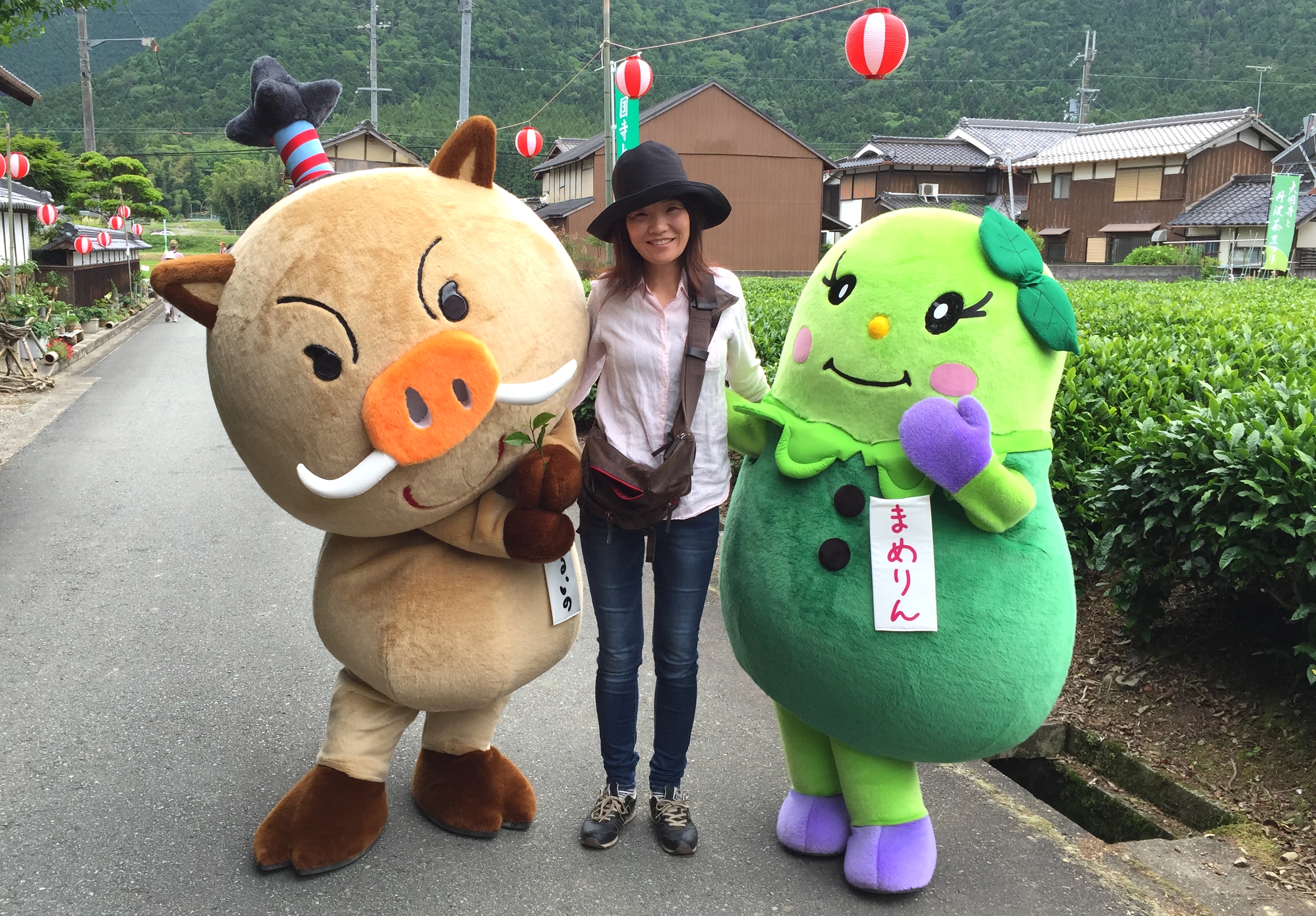
Masumi at the Daikokuji Tea Festival
While Japan is called The Land of the Rising Sun, my personal preference actually would be The Land of the Festivals. The entire calendar is littered with fascinating, extremely entertaining, family-oriented festivals.
I can think of no equivalent in the U.S. to what goes on here. Yes, we have rock festivals and various other extravaganzas. But they are very specific to a type of event and usually local. Here in Japan, the festivals are both a local and a national phenomenon.
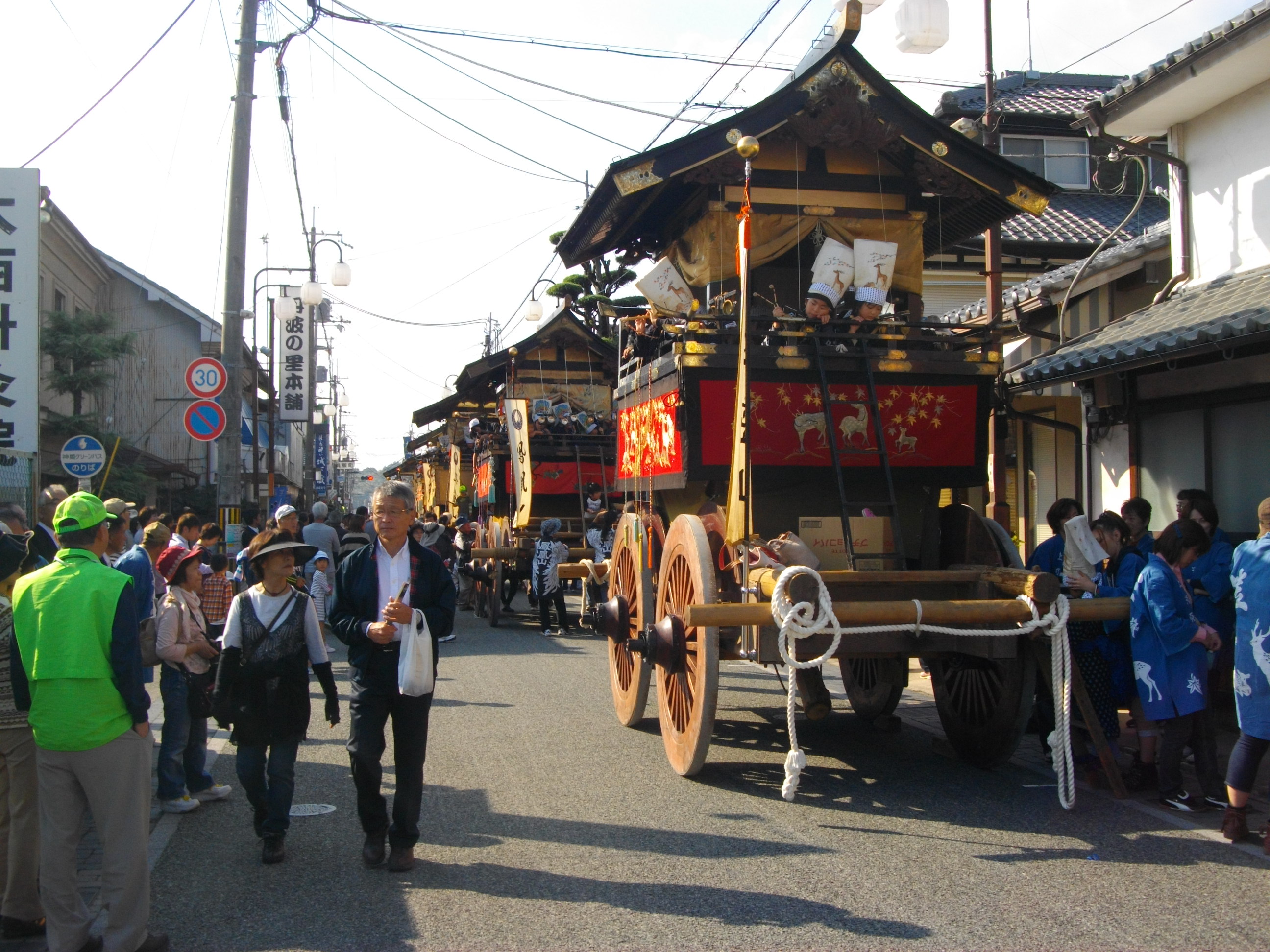
Festival of the Portable Shrines
Some local festivals are unique to a town or region. Here in Sasayama, we have the Wild Boar Festival that fits into that category. Not really too many wild boars running loose in Osaka or Tokyo that I know of. We also have our Black Bean Festival, because Sasayama is renowned across Japan for the quality of its soybeans (black beans are soybeans which have ripened and dried on the vine and are black in color).
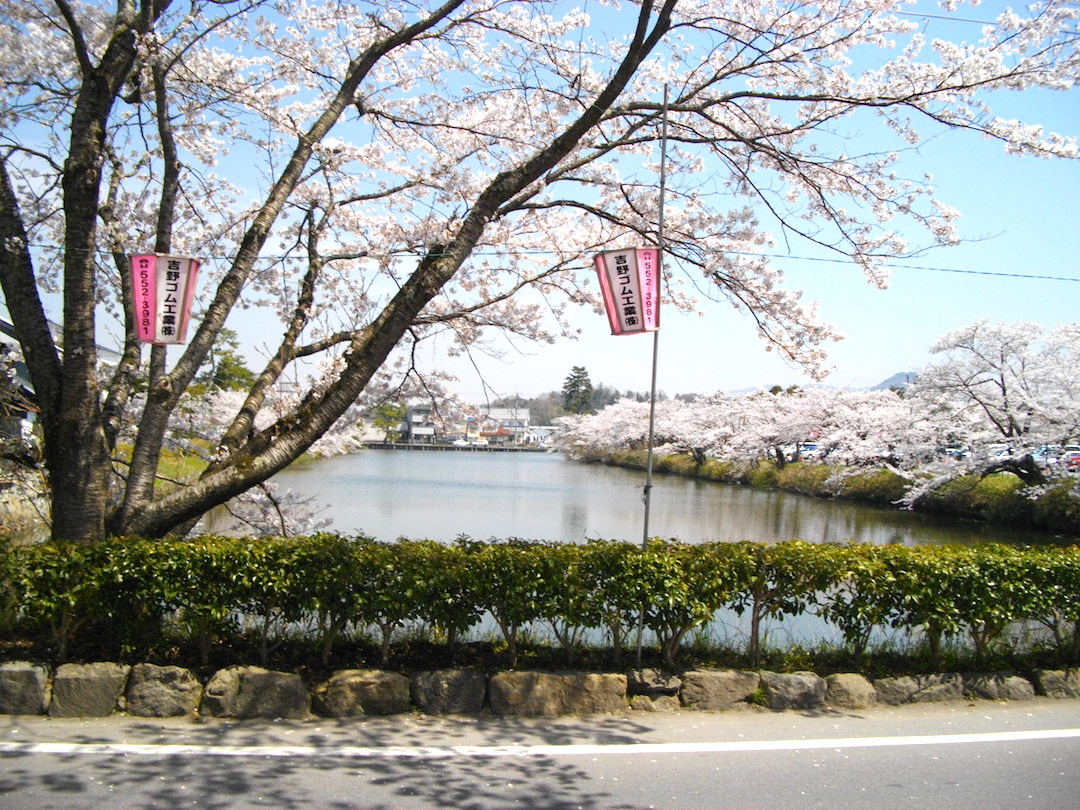
Cherry Blossom Festival
The big festivals are national. Yes each locale or region has a celebration. But the festival being celebrated usually is being celebrated across all of Japan at the same time. Examples of this are the Cherry Blossom Festival early April and the Festival of the Portable Shrines in late October.
Obon is yet another national celebration, actually an annual Buddhist event first half of August, commemorating one's ancestors. It is one of the three busiest times of the year in Japan for travel and taking a holiday break. Everywhere in Japan, there are Obon festivals being held.
This year, my wife Masumi and I headed north to Tohoku for two weeks of camping and attending some of the most famous of these Obon events in the country.
Everywhere we went, there were fireworks, parades, singing and dancing. Here are a few of the highlights.
Aomori
This is reputed to be one of the most spectacular festivals in Japan. The giant internally-lit paper floats are astonishing. The crowd is rowdy -- well, as rowdy as it gets here in Japan -- the drumming tribal. Quite a show!
Yamagata
This was my favorite festival. The participants sang and danced. I loved the song they were singing. The costumes, the choreography, the town itself ... superb!
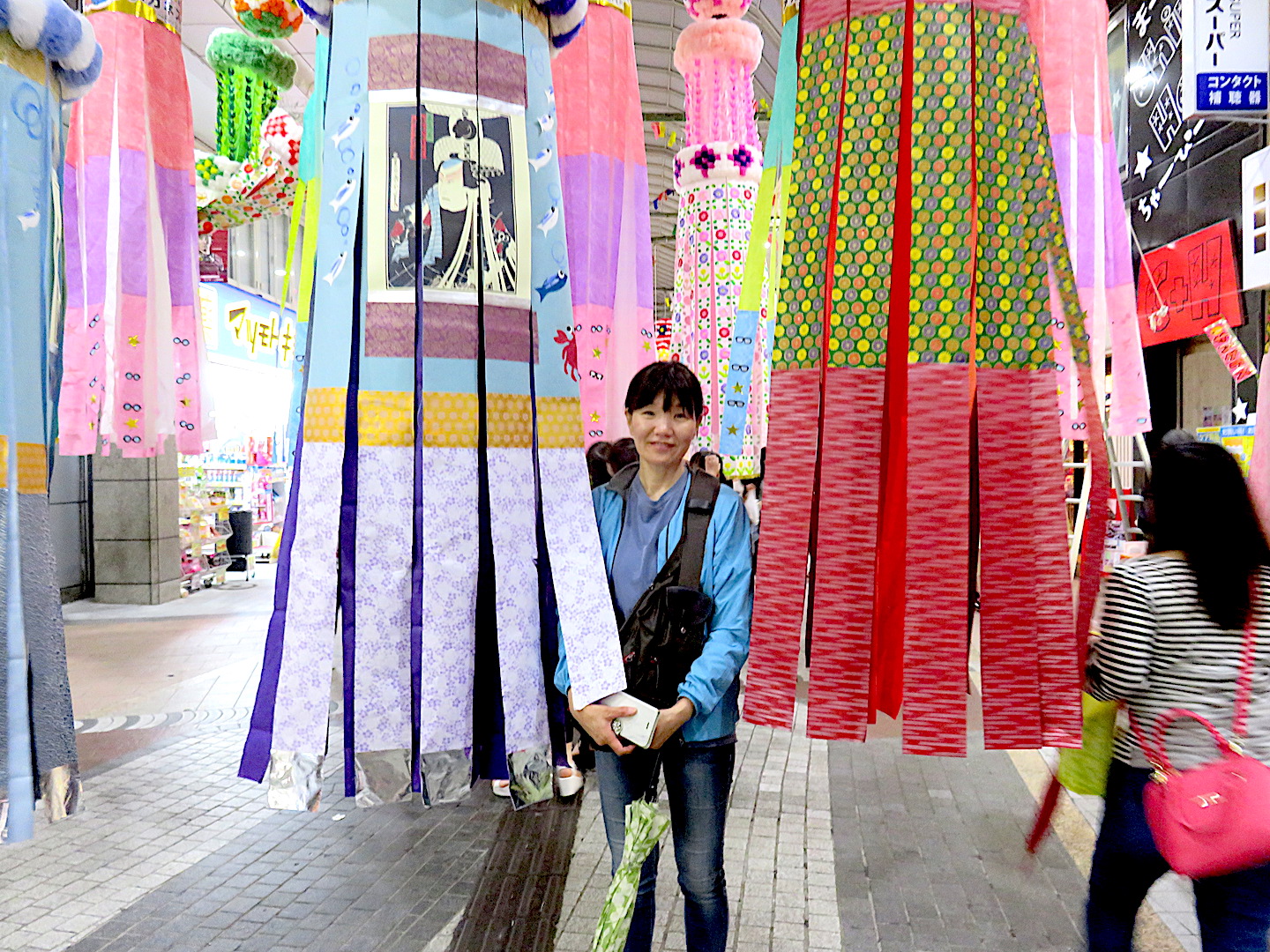
Sendai
Sendai -- famous for its proximity to Fukushima -- was more of a gallery affair than a rollicking good-time festival. Hanging in the promenades which are ubiquitous in urban settings here in Japan were beautiful hanging paper sculptures, literally thousands of them.
We returned from our excursion just in time for the Dekansho Festival, this one unique to our town and one of my favorite local annual events. The music is traditional and live, and everyday folks perform the Dekansho folk dance. The event celebrates the harvesting of the rice and is hundreds of years old, representing the long agricultural roots of this community.
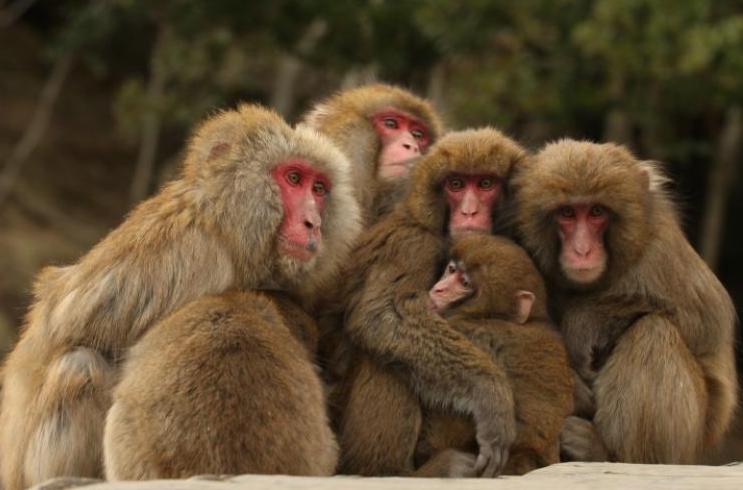
Yes, we have monkeys in Japan, right where I live.
There are an estimated 950 in Hyogo Prefecture -- a prefecture is the equivalent of a state and Japan has 47 total -- and 180 of the critters in Sasayama, Hyogo, my hometown.
Not that we see them that often. But I have seen them.
Once on a bike ride very close to my house, I spotted one in a farmer's field, sitting in the midst of rows of beautiful, ripe vegetables, enjoying his own personal buffet. He was very mature, rather large, not a monkey I'd want to mess with.
Speaking of which, my step-daughter got into her car one morning, and a smaller but extremely upset macaque -- that's the variety we have here, pictured above -- jumped on her hood, issued all sorts of threatening gestures, screeches, and probably even monkey expletives, about some matter none of us have any clue about. It might have been related to the presence in the house of my step-daughter's black labrador, as monkeys -- at least our local monkeys -- are fascinated with domesticated dogs. The incident ended without any damage to her car, the mirrors and windshield wipers still in place, with the monkey bounding off to its next soapbox to lodge complaints about whatever crises monkeys believe warrant their histrionic objections.
It's not as if we're not trying to coexist with our furry friends. There's room for all.
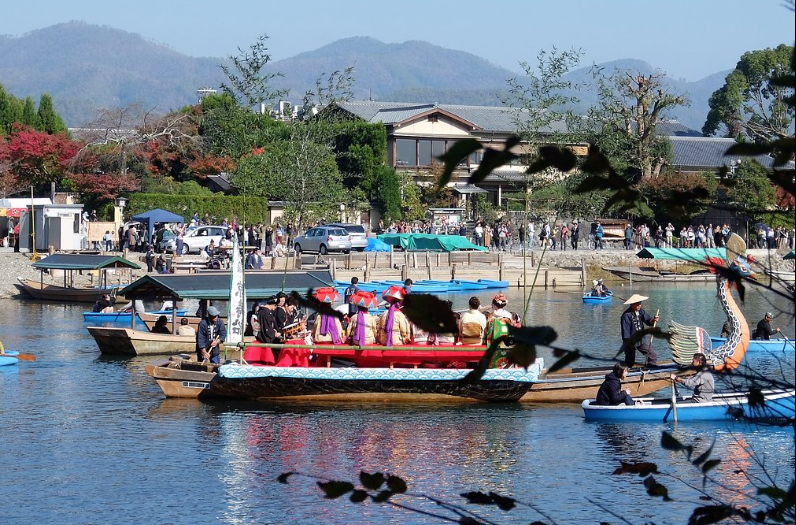
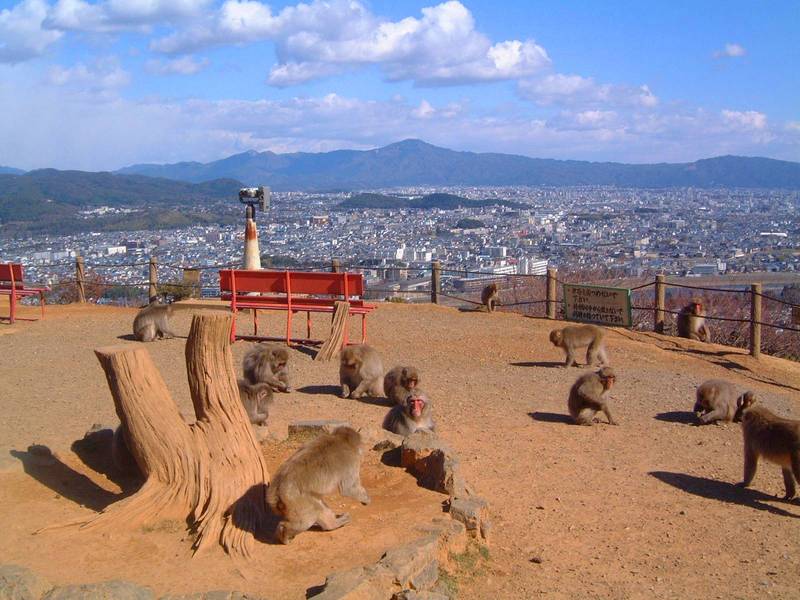
There's a park in Kyoto -- the Iwayatama monkey park. If you're ever in that city, I highly recommend it. The park is a short walk across the Oi River from Arashiyama, a must-see district with many interesting temples, shrines, stores, a bamboo forest, the site for a number of wonderful festivals. For about $100, you can get made up head-to-toe as a geisha, something I would love to do, even if it would understandably put my sexuality in serious question among my Western friends. Here in Japan, they're not so hung up on such matters. There are many celebrities, some of whom regularly appear on television, who are either transvestites or transexuals.
Anyway, getting back to the monkey park. It's on top of a modest-size mountain. The hike alone is worth it, up a splendid trail through the forest which covers the entire mountain until you reach the summit. On top you'll find over 200 monkeys, hanging out, looking for food handouts -- you can buy appropriate nutritional items from the park station -- doing what monkeys on public display typically do. You are cautioned to NEVER look them squarely in the eyes, as they take that as confrontation, a sign that you are threatening and are ready for battle.
I've taken this advice and extended it to all my human interactions, especially with anyone in the West. I never look them in the eye. If they're American, they probably are armed to the teeth and that would be the end of John Rachel. No more monkey sightings or even my characteristic monkey business.
Banana anyone?
[ This originated at the author's personal webpage . . . http://jdrachel.com ]
As a novelist, satirist, essayist, political blogger, and someone who has not gotten beyond the I-want-my-oompa-loompa stage of human development, to say I crave attention is a vast understatement.
Of course I live in Japan, so while I continue my lifelong efforts to become a household name in America, I consider recognition here an important part of building my legend. Plus I've long been a believer that any press is good press, anywhere on the planet.
I can't say I'm making much headway. I've tried countless ways to breach the media firewall that keeps me hidden from the Japanese public eye. A while ago I tried burning down the largest wooden Buddha in Japan. I couldn't get the damn thing lit. Once I tried dressing up as a geisha. All that happened was I got a lot of very strange looks and one comment from a young school boy in a baseball uniform -- その醜い女性を見てください。-- which my wife, Masumi, said basically translates as: "Look at that ugly woman."
I even entered an octopus eating contest and came in last! But not before I started to hallucinate giant sea cucumbers dancing across the stage like an entire chorus line of Rockettes had turned into wart-infested pickles.
Yes, I've tried everything except running through the center of town dressed as a samurai, carrying a bamboo pole wrapped with flaming kelp leaves, while yelling, 'The Emperor has no oompa-loompa.' I ruled that out when I found out he doesn't.
My most recent humiliation occurred the other day, early one morning.
We still get a newspaper delivered to our house every day -- can you believe it? made of paper no less? -- which mentions one or two major news stories but mostly focuses on news from around our prefecture -- which is the equivalent of a state in the U.S. Many human interest stories, local sports teams, city and school district events.
But . . .
There it was! A brief mention to be sure, but no less humbling. My cat upstaged me by getting in the news!
Now I love Arthur to pieces. And I have no doubt he deserves any and all the great press he can get. But let's be honest. He didn't do a thing to deserve this. He's just so cute, an old guy like me, regardless of how many books I write, web sites I put up, despite how funny I am, or "politically aware", how can I compete? Let's be blunt: I don't stand a canary's chance in a cat cafe.
O
kay. Okay. I sound like I'm bitter. I'm not. I'm so proud of Arthur! If anything, I'm wondering why they didn't put him on the front page and do an exclusive feature story on the little guy, including an interview and a link to video footage of him being so darn cute!
At the same time . . .
That still leaves me in a quandary. What do I have to do to get some press around here? Dress up like an American soldier and fly an Osprey into the Tokyo Tower?
Of course I remember the typical New Years holiday celebrations in the U.S.!
The
shots of Buttery Nipples, Afterburners, and White Gummy Bears, the beer
chugging contests, DUIs, the streaking of police patrol cars, mooning
at McDonald's drive-thru, the totaled rental cars, 72-hour hangovers,
the arrest warrants, getting herpes from kissing some stranger at
midnight, the Rose Parade, lying in the den in a puke-soaked Kurt Cobain
sweat shirt through 12 hours of football -- Rose Bowl, Cotton Bowl,
Orange Bowl, Tangerine Bowl, Toilet Bowl, Oxycontin Bowl.
It's impossible to overstate how different New Years is for me here in Japan.
Granted,
there might be some revelry in the big cities like Osaka and Tokyo.
Compared to what typically goes on in America, even these are more like
Thursday afternoon bingo in Butte, Montana or octogenarian shuffleboard
in Sun City, Florida.
Fasten
your seat belts, people, to keep from falling off your chair when you
nod off reading this. A pot of hearty espresso is recommended if you're
serious about making it to the end.
New Years Eve day, Masumi, her daughter Azusa, and I, climbed a mountain I've written abouttwicebefore.
It looks like a mountain but it's really not that high. It has steps
and trails, so we left the GPS, emergency flares, ropes, and rappelling
gear at home. What I like about it, besides offering a decent work out,
a couple hours in nature, and splendid views of the valley which
contains most of my home town,Sasayama, is that by bike it's only about five minutes from my house. It couldn't be more convenient.
This
time, we also brought Azusa's Black Labrador puppy too. We all headed
over -- Azusa on foot, Masumi and I on our bikes -- to the trail head,
which is situated right in front of a small shrine. Of course! Shrines
are as ubiquitous here as fire hydrants are in the States. Anyway,
about 45 minutes later, we were on top the small mountain, had a picnic
lunch, then returned on the same trail.
It
was cool but comfortable, perfect for this relatively easy hike.
However, as we made our way back down, the temperature started quickly
dropping. And continued dropping right into the evening.
Masumi
and I had the option of visiting the grounds of a local temple to "ring
in the New Year". They have a No Theater performance, a bonfire, and
serve free non-alcoholic sake. This is a real family affair for all
ages.
But we decided it was just too damn cold!
So
we stayed home, falling asleep before midnight. We missed the tofu
cannons, whale juggling, sky diving ninjas, and laser holograms of
Godzilla eating the Moon. This was prudent. We needed to rest up for
the next wild and dazzling phase of our extended weekend, Land of the
Rising Sun New Years extravaganza, set for next morning.
That would be at べんてん神社
(Benten Shrine), the Shinto shrine which belongs to our village. We
live on the very east end of Sasayama proper, in a village called Noma.
Each village of several in our city of 50,000 or so typically has its
own shrine and community center. Living in Japan is about community life and getting to know your neighbors.
The
motif at the shrine was similar to what we missed at the big temple
downtown the previous evening. There was a small bonfire, free kelp and
squid snacks, and sake. This sake was the real stuff but only
dispensed in thimblefuls, so no one exactly got rowdy.
This
being a shrine and to the rather meager extent that Japanese indulge in
religious services, there was singing. Mind you, this bore no
resemblance to Handel's Hallelujah chorus or a medley of tent revival
spirituals. In fact, what we apparently were singing was the national
anthem, which is why my lovely, principled wife was not singing along.
She is categorically and staunchly opposed to nationalism, even
superficial celebrations of what has not served humankind very well over
its blood-soaked history. Which explains why I had to burn all of my
American flag Hanes boxer shorts right after we got married.
Of
course, anyone who knows me knows that I am joking. All of my American
flag undies were long gone decades ago. I believe they were used as
rags to stuff Molotov cocktails at some street protests in Berkeley back
in the late 60s. I can't say for sure. It's difficult to track where
things end up after you drop them in a Salvation Army collection box.
Let
me add that Masumi thought the idea of singing the national anthem on
this special occasion was very strange, a total anomaly. Somebody
certainly made a very odd choice. Personally, I found it to be a rather
doleful affair, not the stuff of conquest and plunder.
Anyway, here's a very short video clip of my neighbors singing at the shrine.
Okay . . .
Enough
is never enough, especially when it comes to wild abandon and revelry.
Sure, we were exhausted from all the whoopee. But driven by relentless
surges of hedonism and the insatiable urge to party like its 2099, as
soon as we got home we decided to go to Kaibara, the town both near to
where Masumi grew up and where we officially got married.
柏原八幡宮 (Hachiman Shrine) is a beautiful place at the top of a hill. It maybe takes ten minutes to walk up the stairs.
People
step to the front of a shrine, make a contribution, sometimes light
incense, ring a very dissonant, clanking bell to get the attention of
whoever might be listening, then make an appeal for some improvement in
their lives -- new husband, better job, health, long life, happiness,
money -- the usual things. They also write these requests on pieces of
paper and tie them to a tree on the grounds.
Whew! Wild and crazy times here in Japan, eh? We know how to party! Personally, I find this all very calming, informal, charming, especially since I mercilessly was subjected to thetortures of the Catholic Massfor way too many years. What can I say? Buddhism and Shintoism rock!
I'll
end this account on what I find an interesting note. While there is
some god, a spirit entity, associated with each shrine -- our local
shrine described above is in dedicated to Benten, goddess of art, music,
literature, especially appropriate for Masumi and I -- the Japanese,
and most Asian people, especially Buddhists, don't pray to a
specific god, saint, angel, virgin. At least not the way Christians
do. The Catholic Church has a precise org chart for all of its holy
representatives. St. Christopher was assigned assuring safe travel, St.
Anthony unobstructed breathing passages. Then there was the Virgin
Mary, who had what could only be called a cult following of her own,
rivaling that of Jesus, who of course was the Savior, source of
salvation. Asians just send their prayers out, as Masumi tried to patiently explain to me. Buddhists are very much into flooding outer space with prayers.
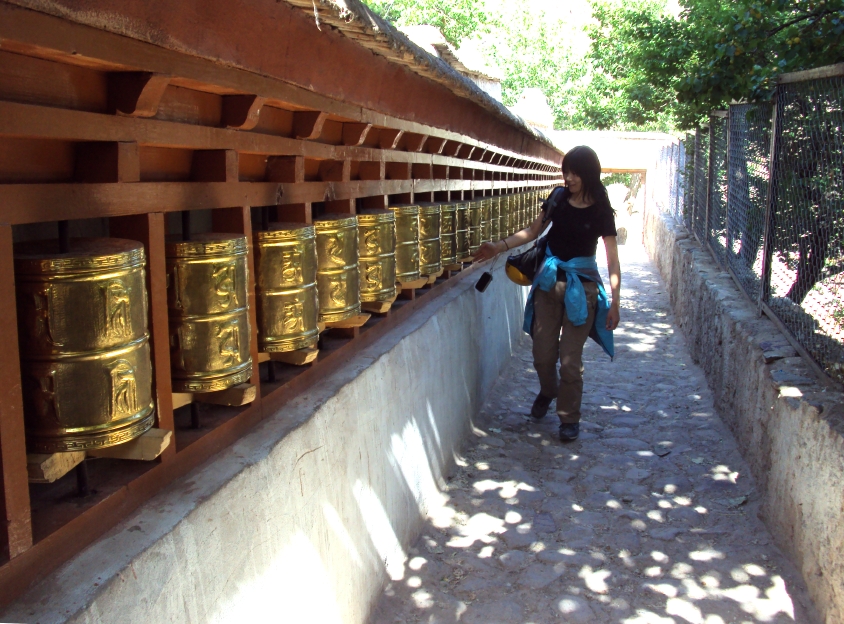
You may find this interesting. When you visit Buddhist monasteries, you see prayer wheels, hundreds
of them, all different sizes, from ones which could fit in a bowling
bag to ones that are taller than a human. Each prayer wheel contains
hundreds -- sometimes even thousands! -- of sacred inscriptions from
holy Buddhist texts. Again we have appeals for peace, harmony, long
life, etc. Spinning a prayer wheel, it is claimed, sends these good
messages out into the universe, inundating it with the highest spiritual
content and aspirations.
While
from what I can tell, it's not working, it's most certainly an
admirable enterprise, and so different from the Western framework of a
person's relationship with God and his heavenly ecclesiastical staff.
Take a moment and picture those televangelists, furrowed brows sweating,
faces bulging with the power of the Lord, yelling: "You want that new
car? You want your bills paid? You want that ugly goiter to
disappear? To be able to sing along with Mariah Carey and slam dunk
like the Shaq? Well, just put your hands on your television screen! I
say, put 'em both right here on my face, and FEEL THE POWER OF THE LORD
FILL YOUR LIFE with money, success, happiness! Ask and ye shall
receive! PRAISE GOD!"
Just something to think about next year during half-time of the Rose Bowl.
[ To see all of the photos, go to author's personal website . . . http://jdrachel.com ]
I just looked at my last five posts and they are all about the same topic.
Listen, folks. I truly get it. A lot of people think I'm becoming a tedious bore.
But they're wrong! I've always
been a tedious bore. Sometimes I'm able to disguise it better than
others, dress up my dull, monotonous discursives a bit with some clever
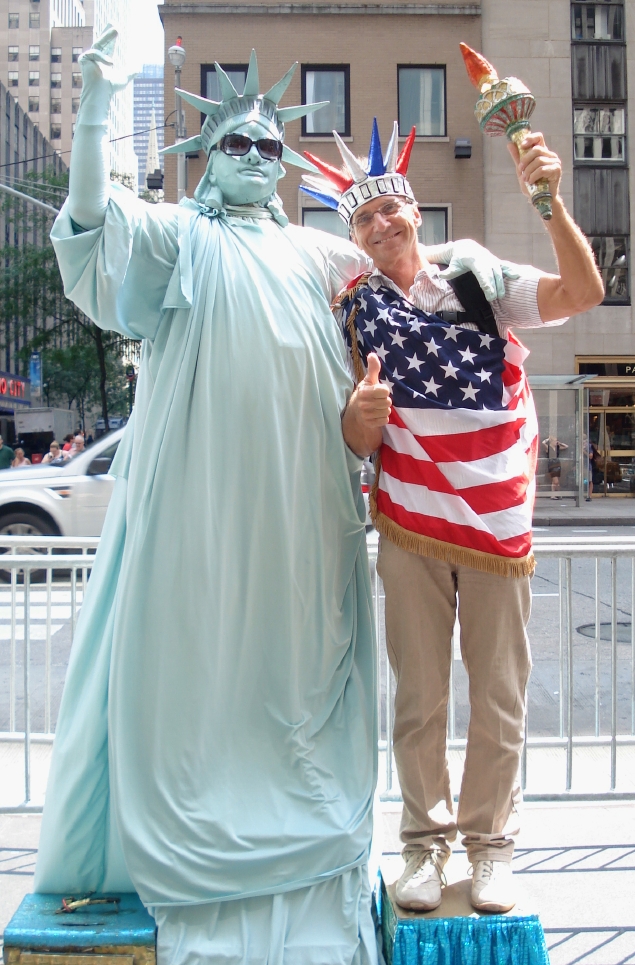
photo -- like the pandering photo to the right.
But I can hear the recent cries of anguish from my readers.
"Jesus H. Christ! Yet another article on candidate contracts? Is this guy a one-trick pony?"
Actually,
the last time I checked I had thousands of tricks. The thing is, two
in particular stand out spectacularly from the rest. So maybe I'm a
two-trick pony?
These
particular two stand out, because as far as I can see, both of them
offer necessary tactics and solutions to the existential threat ripping
our nation apart. It's one huge, ugly monster with two heads:
Autocratic rule by a rich and powerful elite and psychotic levels of
militarism and imperial aggression.
It's been a real interesting ride these last five years trying to promote candidate contracts and the Peace Dividend refund
concept, both targeting the oligarchy's sinister, iron-fisted
authoritarian grip on our politics -- and just about everything else --
and the creation of a military/security state to further tighten and
reinforce that grip on the American citizenry and any other country
which holds valuable resources ripe for plunder.
I've
made my case in three books, and literally hundreds of articles. With
this much time invested, and a firm belief that despite a lack of much
encouragement I'm onto something of value and positive potential, I'm
not giving up. Sometimes you go with your gut.
Both
the candidate contract strategy and Peace Dividend concept have had
more than their share of detractors. Yet I forge on like a punch-drunk
old boxer because no one -- NO ONE -- has come up with anything
resembling a coherent, decisive reason why either of these detailed
battle plans is not viable, why they're dead ends, why they're lost
causes, why I should pack it in and live in a Yurt with some nomadic tribe in Mongolia.
I'm serious! Any criticism dances around them like they're made of depleted uranium.
I get self-assured quips like: "It'll never happen." Wow! That crushed five years of hard work in a single blow.
Or: "I don't like contracts." Which is a semi-literate version of, "Your idea sucks, dude!"
One very famous activist -- I won't name him because everyone who would bother to read this knows this guy -- ripped my book,Candidate Contracts: Taking Back Our Democracyto
shreds. I'll give him credit for putting a lot of time into his
demolition project. He sent me a long email listing in great detail
seven flaws in my approach. The only problem was, not one of the seven
things he targeted were even in my book! I am dead serious. Not a single one of the seven gaping holes in my plan were in my plan. As I suspect happens a lot, he saw 'candidate contracts', then proceeded to dissect what he thought a candidate contractstrategy would be about. Talk about arrogant posturing. And this guy is veryfamous! Progressives from all over flock to his side for his sage advice. God help us!
I
beg people to give me constructive criticism, any kind of criticism, a
bombshell that takes my ideas out like they'd just been hit by aMOAB. Hey,
put me out of my misery! I've got four novels I'd much rather be
working on. PLEASE! Give me your best shot. Deliver me from all this
yelling in ananechoic chamberat ghosts who are hologram doppelgangers for activists in a coma.
I'm
still waiting. How many articles have I written here, at OpEdNews, The
Greanville Post? Hundreds! Now go through the comments. A lot of the
real critical stuff is self-aggrandizing bloviating, the rest
irrefutable evidence that either they didn't read the article, or they
must have put their brains in a fruit blender before they tried to read
it, because obviously they didn't understand anything of what I was
saying.
Often I've thought: Maybe it's you, John. Maybe you're not expressing yourself very clearly and that's why people don't get it. (I
spend a lot of time alone, so it's not that unusual for me to talk to
myself, though usually it's a little more upbeat than this.)
The
result has been the vast output of a variety of articles, each coming
from a slightly different place, offering a different pitch, trying to
find that magic winning formula for getting the ideas across. I've even
resorted to doingvideos, despite
the fact that if I had the money, the first thing I'd do is hire an
actor with a great voice and reality show-host good looks to deliver a
more seductive version of the message.
Mind
you, I have a phenomenal life here in Japan. Except for the gnawing
aggravation and frustration associated with my long-distance dedication
to activism, I live a fairy tale life in abeautiful, traditional, rural communitysituated
between Osaka, Kobe, and Kyoto -- each one of those comes with its own
distinct personality and host of urban attractions. My beautiful,
talented Japanese wife and I travel extensively, with her showing me the splendors of this fascinating country which I now embrace as my home.
But
when I look back at the "homeland", I want to scream! What has
happened to the U.S. is a nightmare of a nightmare of a nervous
breakdown. In my worst moments, I see the whole world -- including my
charming town -- being plunged into a nuclear holocaust, a war driven by
pride, hubris, arrogance, ignorance, insensitivity, delusion,
demagoguery, pathological levels of disregard for decency and human
life. In my better moments -- fewer and farther between these days -- I
just see America being consigned to the septic tank of history, plunged
into the dank, degrading stink hole of a Dark Ages Redux.
But
there's three compelling reason why I'll continue pushing -- at least
for a while -- my two apparently incomprehensible strategies.
There's
a pivotal election coming up. Forget about 2020. We might not even
make it to 2020. A lot depends on whether the accelerating implosion of
our country and the decline of the fortunes of everyday people
continues, or finally meets its Waterloo. It's up to us and that's why I
keep fighting.
Very recently I've had some encouraging breakthroughs. One gentleman in Scranton, Pennsylvania bought 20 print copies of myPeace Dividendbook,
handed them out to all of his friends and fell0w-activists. Now they
regularly discuss the strategy in their peace planning sessions.
[Author stops, spots a frog stuck to the window next to his chair, prompting him to reflect: Is
this as tedious as I think it is? Maybe I should wrap this up. Ah!
I'll throw in the old non-sequitur. That always gets them where the
rubber meets the cerebellum!]
1st Rule of Fight Club: Don't talk about fight club.
1st Rule of Propaganda: Repeat lies so often people eventually believe them.
1st Rule of Activism: Repeat truth so often people start paying attention.
Alright, enough. My mind spilleth over . . . and it's a mess.
Having
said all of the foregoing -- are you still with me? . . . doubtful but
as a tedious bore, I'm used to rejection -- I'm going to take a short
break. The next two or three articles will not be hard-core political but family-friendly fluff.
Just because I can.
Or is it by popular demand?
[ This originated at the author's personal website . . . http://jdrachel.com ]