Showing posts with label koban. Show all posts

Thursday, October 7, 2021

Life In Japan: Police Power IV

The police here in Tambasasayama at work!

Yes, here we have another example of hard-core law enforcement here in my hometown.

Pictured is a local police officer and his wife. They’ve taken it upon themselves to make an Amabie doll for their Koban — their local community police station — and extend an open invitation to everyone in the neighborhood to stop by.

While much of the world appears to be reeling from Covid-19, with piles of bodies filling the streets and morgues in cities across the globe, life is pretty normal here. We do have a declared “state of emergency”, meaning some events have been canceled, a few restaurants are closed. But honestly, other than not being able to travel internationally, my life is quite normal. Deaths in Japan are not up from previous years. In fact, overall they are down!

What’s Japan’s secret?

Well, I’m not a medical expert nor am I here to give medical advice and risk the wrath of the WHO, Facebook, Dr. Anthony Fauci, and the CDC. If I get censored, the six people who normally would read this article won’t see it. That would be a tragedy of epic proportions. So I’m just reporting what’s happening here on the ground.
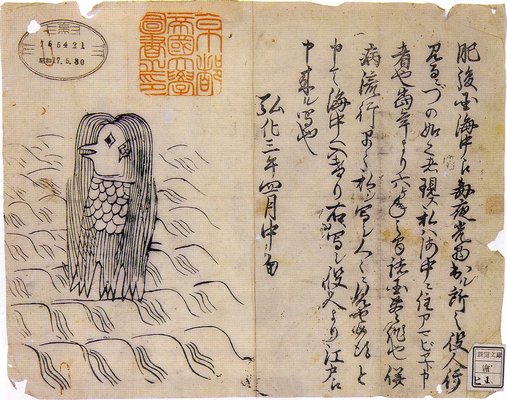
The Amabie. Woodblock print, late Edo period, dated Kōka 3 (1846).

Back to Amabie.

From Wikipedia: “Amabie (アマビエ) is a legendary Japanese mermaid or merman with a bird-beak like mouth and three legs or tail-fins, who allegedly emerges from the sea, prophesies either an abundant harvest or an epidemic, and instructed people to make copies of its likeness to defend against illness.”

You caught that last sentence?

“To defend against illness.”

Fact: We’ve had few people sick with Covid-19 here in Tambasasayama and no deaths!

You can’t argue with results. AMABIE!

While people in the U.S. are arguing about the effectiveness of Hydroxychloroquine and Ivermectin, ramping up to get everyone vaccinated — including now even kids — we have here a police officer making available to those visiting his Koban, a handmade doll based on a mythical mermaid, because legend has it that Amabie is the key to staying healthy.

But wait . . . what has this got to do with police work?

The short answer is nothing. But frankly, he’s not exactly busy. A crime wave here is a person parking their motorbike on the sidewalk. Even that doesn’t happen very often.

Being a news junkie of sorts and a U.S. citizen, I try to keep up with what’s going on in the homeland. I can’t say it’s encouraging or inspiring. Putting aside the circus/nightmare of the politics there; the appalling health care crisis exacerbated by the complete failure in properly handling Covid-19; the censorship and childish level of what is tolerated, even lauded, as debate and discussion of important issues; America’s compulsive meddling in the affairs of everyone else on Earth, while the U.S. itself falls apart; there’s the frightening rise of what can only be called a police state. Thus when I scan the headlines, I’m treated to a seemingly endless parade of stories about police harassing, beating, and shooting people, everyday citizens many unarmed, most of them with skin of the darker shades. It’s truly sickening and though I’m not one to easily succumb to paranoia, I can honestly say I have no desire to return in the foreseeable future just to see how good I am at dodging bullets or how well I handle pepper sprayzip ties, or being assaulted by thugs in or out of uniform.

It’s hard to exaggerate the contrast of what looks like the horror show of police brutality in the U.S. with what life is like here. But I’ve tried to capture it in a few stories. I wrote Police Power III back in March of this year.

Police Power I and Police Power II are part of my collection of 63 anecdotes about life in the REAL JAPAN for me as an expat. It’s getting fantastic reviews and I believe it will put a lot of smiles out into the world, as well as valuable insights into this fascinating country. Available across the globe for the asking, you are welcome to visit the dedicated page on my author website and get a copy from the online bookstore of your choice.

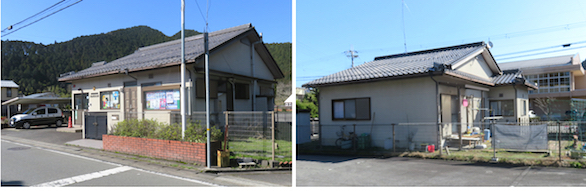
An interesting side note to close on: There are quite a few Koban here in town. By sheer coincidence, the Koban featured in the article pictured at the top happens to be one that I wrote about in my book. It’s right in front of the yurt where I used to teach English. Here’s what this police officer’s office/home looks like front and back.
That’s about it. Not very exciting, eh? But I’ll keep you posted if there are any shoot-outs, gang battles, drive-by killings, riots, or if some hardened criminal parks his motor scooter on the sidewalk.



[ This originated at the author's personal website . . . https://jdrachel.com ]


Life In Japan: Police Power IV | John Rachel


Sunday, September 13, 2020

Life In Japan: Awe-Inspiring Extreme Honesty | John Rachel

The sub-title of my newest book begins “Anecdotes on the People and Culture of Contemporary Japan …”

Here are a few anecdotes which will give you phenomenal insights into the remarkably high ethical standards and general character of the Japanese people.

•  •  •

Text Box:

A friend of mine, originally from New Zealand but who lives in Japan, left her latest model Macbook Pro in a train station ladies room. For two hours! She had left it on the counter while she washed her hands and forgetfully walked out without it. By the way, this was one of the busiest hubs in Japan, the Umeda JR Station in Osaka. That restroom has hundreds of people going through it every hour. She got quite a ways along on her trip back here to Sasayama, remembered, jumped off, and immediately got on a train back to Osaka. She found her laptop right where she left it. Yes … two hours later!

•  •  •

Every year in October, we have here in Sasayama the Festival of the Portable Shrines. It’s one of my favorites!

Text Box:

A gentleman arrived here from Kobe, which is about an hour away. He came to purchase black beans, an item my home town is famous for, but when the moment came to pay, he discovered his wallet was missing. 

There are no pickpockets around here, so obviously he had dropped his wallet somewhere in town.

He went to the nearest Koban. There are several here in Sasayama, as there are all over Japan. A Koban is a mini-police station. In Japan, it’s considered an integral part of a functioning community. The Koban is to make sure there are friendly cops in the neighborhood to address problems which come up in the local area, situations just like this.

The policeman on duty took a report, then got on the phone. He called all the other Kobans in the immediate area, anywhere close to where the gentleman had parked his car, before walking into the main part of town for the festivities.

He passed along the man’s name and a description of the wallet. Now get this …

While the officer was on the phone with another Koban, someone walked in with the wallet and handed it to the policeman on duty there.

The gentleman from Kobe then walked the short distance to the other Koban, and retrieved his wallet. The contents — credit cards, ID, cash — were intact. Not a single item had been taken.

•  •  •

One Sunday many months ago, we went to, Rurikei, our favorite local onsen. This is one of the great joys of living here in Japan and we try to go often (see next section).

Anyway, I left my hair brush in the mens locker room. This was not a family heirloom. This was an 89 cent piece of plastic, dirty and full of my hair from use over many months. The only thing it had going for it was that it was a pleasant shade of lavender.

Five weeks later, we returned to the hot springs. On some impulse — my synapses tend to fire randomly at times — I asked at the counter if they had a purple hair brush in their lost-and-found box. Stupid me. I was thinking they had a cardboard box behind the desk. The clerk asked when I thought I had lost it. That was easy. Maybe four or five weeks ago? He stepped into the facility’s main office, consulted with someone, then returned with my 89-cent hair brush, safely contained in a sealed plastic bag with a label. On the label was the date I left it in the locker room.

•  •  •

Text Box:

Masumi reminded me of this story, one I had forgotten. One day we went to Japan Post to mail a package to the U.S. — I think it was one of my novels, sent off for a review. Shortly after we returned, the phone rang. It was the clerk who had waited on me at the post office. She first apologized. She had made a mistake and overcharged me. She was so sorry this happened! It was an honest mistake and would be happy to refund the money. How much was it? 10 yen. Unbelievable! Do you know how much 10 yen is at current exchange rates? 9.44 cents!

What did I do? I did what any red-blooded American would do in the face of such incompetence! I went to the post office with my AR-15 and shot the place up. I didn’t kill anyone, though obviously I could hardly be blamed if I had. But when I got done, the place looked like one of the Twin Towers on September 12!

Okay. Obviously, I made that up. The truth was, I was speechless. 10 yen? After I stopped laughing — pleasant, joyful laughing — I had Masumi tell the clerk all was forgiven and she could keep the 10 yen. I think you can probably buy a lollipop somewhere for 10 yen.

•  •  •

I could go on and on. For example, in the news several months ago, there was the story of a person who had found a satchel on a park bench with over 5 million yen (that’s $50,000 cash) and no identification of any kind in or on the bag. It was promptly turned into the police.

I’m not going to moralize. Draw your own conclusions.

But by seeing such extreme honesty here, I see what has happened to my own country. I’m not pointing fingers. I see it in my own thinking. It’s been quite an adjustment for me. After all, I grew up in a tug-of-war between what I was taught at home, school and church, and real world a prioris: ‘Finders keepers losers weepers.’ ‘It’s every man for himself.’ ‘If I don’t take it someone else will.’

As a kid, often it wasn’t a question of right or wrong, but a question of whether we’d get caught.

I will say that dishonesty, regardless of how minor or seemingly insignificant, is a slippery slope. The Japanese have chosen to avoid taking even the first step.

I openly admit, it’s resulted in a huge paradigm shift for me. It’s required an enormous adjustment. But an extremely rewarding one. Just imagine … being able to trust other people. What a concept!

Understand: This extreme level of honesty and respect for the property of others I’m describing here is not an anomaly. It’s the norm. And it’s nothing new.

My American friend, Scott Burley, recently emailed me about his brief but rewarding experiences visiting Japan. He included this story:

My girlfriend who I met sophomore year … went on a student exchange program to Tokyo for her junior year and went to school over there. She was 1/2 Japanese and 1/2 Czech and her parents were both Japanese — her mother must have married a Czech before her step father. So around Christmas I flew to Tokyo when she had Christmas break and we spent three weeks traveling by train … my girlfriend left her purse at a bus stop. I went back to look for it and it was gone. After we got back to Tokyo, one day her purse arrived in the mail. Only in Japan!

That was back in 1973. Some things don’t change here.

Sometimes it’s best when they don’t.


[ This originated at the author's personal website . . . https://jdrachel.com ]


Life In Japan: Awe-Inspiring Extreme Honesty | John Rachel